


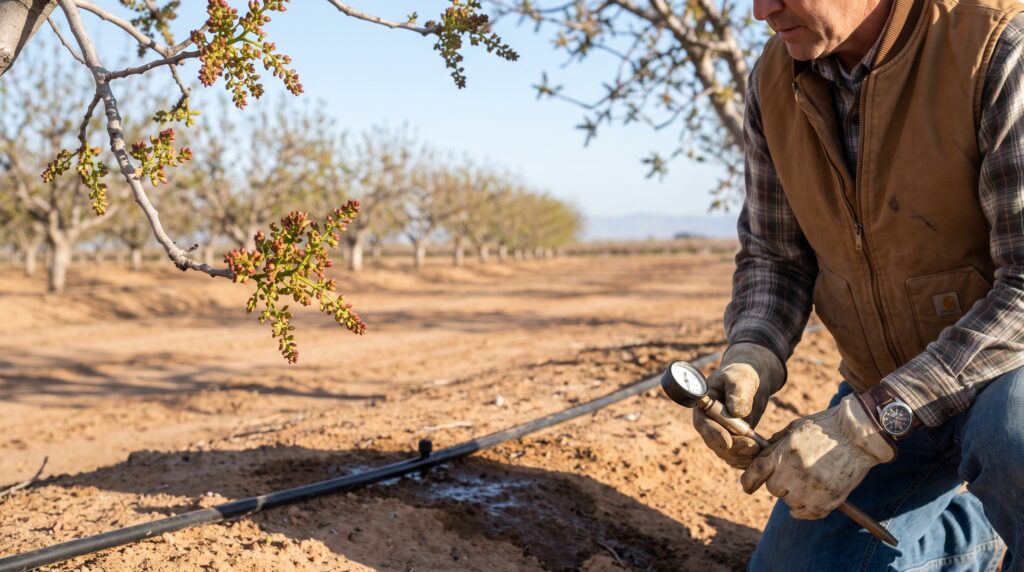
Pistachio irrigation during flowering is decided in just a few weeks, but its consequences show up in the late-summer harvest. 🌳 At Agro Vivero del Mediterráneo, we support growers in the design, start-up and management of pistachio orchards, and we have seen many times that spring does not forgive water errors, whether from too little or too much.
The question we are asked most often is always the same: do you need to irrigate while the tree is in bloom? The short answer is that it depends on the water available in the soil, the soil type, the irrigation system and the weather over those days. The long answer is the one we develop below, with criteria that work equally well for growers starting with a few hectares and for those managing a large operation. 💧
In the following sections, we look at how pistachio flowering works, how much water the tree needs at this stage, which irrigation systems are most suitable, how to measure soil moisture and which mistakes to avoid, with practical examples and tables you can apply directly in your plots.
Why is irrigation during flowering so delicate? 🌸
The pistachio (Pistacia vera) is a hardy crop, and that is precisely why water management is often underestimated. It withstands drought and poor soils better than almost any other woody species, but that does not mean it is indifferent to how we irrigate. In spring, several processes coincide: the tree comes out of dormancy, leaves emerge, the inflorescences open and fruit set is determined, that is, how many flowers will end up becoming nuts.
There are three reasons why this stage demands attention:
- There is no second chance. If flowering goes badly, it cannot be repeated until the following year.
- The tree draws on its reserves. Budbreak, flowering and fruit set depend largely on what was stored the previous year, and stress at this point is paid for later.
- Pistachio roots do not tolerate excess water. A waterlogged soil in spring, with temperatures still cool, favours root asphyxia and disease.
Water is also one of the factors that weighs most heavily on the profitability of a pistachio orchard. It is not about irrigating a lot, but about irrigating well: with gentle, precise irrigation adapted to what the tree needs at each moment. ✅
How pistachio flowering works and when it happens 📅
The pistachio is a dioecious species: there are female trees, which produce the nuts, and male trees, which only provide pollen. Pistachio pollination is wind-driven, so the overlap in flowering between the Kerman variety (the most widely planted female) and the Peter pollinator (the most commonly used male) is decisive.
In inland areas of the Mediterranean region, flowering usually takes place between late March and the first half of April, although it varies with the climate of each year, the altitude and the variety. Each tree flowers for just a few days, and the orchard as a whole takes between two and three weeks to complete the process. In addition, the leaves emerge at practically the same time as the flowers, so the tree still has little leaf area and transpires very little.
This indicative irrigation schedule summarises what we ask of irrigation at each phase:
| Phase | Approximate timing | What happens | What irrigation should provide |
|---|---|---|---|
| Dormancy and bud swell | February-March | The tree wakes up from dormancy | Check the soil water reserve and irrigate if it is lacking |
| Flowering | Late March-April | Inflorescences open and pollination takes place | Stable moisture, without waterlogging |
| Fruit set and budbreak | April-May | Nuts set and leaves develop | Increase irrigation gradually |
| Rapid nut growth | May-June | Water demand soars | Regular, well-distributed irrigation |
These dates are indicative. What matters is the actual condition of the trees, not the calendar.
Pistachio water requirements during flowering 🔢
Here comes the first surprise for many growers: pistachio water requirements during flowering are low. Two figures are used to calculate them. The first is reference evapotranspiration (ET0), which measures the water lost by a reference surface through evaporation and transpiration. The second is the crop coefficient (Kc), which adjusts that figure to each species and each moment. At flowering, the Kc is low, around 0.3-0.5, because the leaves have just emerged and the canopy does not yet cover the ground. Later it rises to values close to 1.
A practical example with an orchard planted at a spacing of 6 × 5 metres (about 333 trees per hectare) and a Kc of 0.4:
| ET0 (mm/day) | Tree requirement (mm/day) | Litres per tree per day | m³/ha per day |
|---|---|---|---|
| 2 | 0.8 | 24 | 8 |
| 3 | 1.2 | 36 | 12 |
| 4 | 1.6 | 48 | 16 |
These figures reflect what the tree demands, not what needs to be applied. Rainfall and the water stored in the soil must be subtracted, and the losses inherent to the system must be added. As an order of magnitude, a mature irrigated orchard usually receives between 2,000 and 4,000 m³/ha over the year depending on climate, soil and irrigation strategy, and flowering accounts for only a small part of that total. 💡
That is why we say that flowering is not the stage when the most water is applied, but the one when it matters most not to make a mistake.
Should you irrigate during full bloom? This is how we decide 🤔
In most years, the key is not to irrigate during flowering, but to arrive at it with the soil well charged with water. When we are asked, we work with three scenarios:
- Rainy winter and soil close to field capacity. Irrigation is normally not needed during flowering. The tree has plenty of water, and irrigating only adds risk.
- Dry winter and a soil profile with a deficit. It is advisable to apply light irrigations before and during flowering so that budbreak does not suffer.
- Warm, windy spring. The soil loses moisture quickly, and short, frequent drip irrigations prevent the tree from suffering without causing waterlogging.
And there are two rules we always apply. The first: if it rains, irrigation is stopped and moisture is measured again before resuming. The second: we never irrigate on a fixed schedule, but according to what the soil, the weather and the condition of the tree tell us. Flexible irrigation management works better than rigid management, especially at such a sensitive stage. 🌦️
An illustrative example: a 10-hectare plot planted at 6 × 5 metres, with loam soil, after a dry winter. At the end of February, the soil pit shows the profile is dry below 40 centimetres, so we apply a pre-bloom irrigation to wet the soil down to about 80 centimetres. During flowering, with an ET0 of 3 mm per day, we replace what the tree consumes, about 36 litres per day, split into two or three irrigations per week and conditioned on probe readings. If it rains for several consecutive days, irrigation is suspended. The goal is uniform budbreak, no waterlogging and a reserve ready for May. ✅
Irrigation before flowering: arriving with a full reserve 🌱
Pre-bloom irrigation, or irrigation before flowering, is for us the most important irrigation of the spring. It consists of refilling the soil profile at the end of winter or the beginning of spring, before the tree starts to consume water, so that nothing has to be forced during flowering.
Three keys to doing it well:
- Wet the root zone, no more. The pistachio has a deep root system, but water must not be lost below it. A soil pit tells us how far the water has reached.
- Avoid saturation. In heavy soils, it is better to split the volume into two irrigations than to apply one very long one.
- Check the installation. Before the season starts, we check filters, pressures, emitters and possible leaks. A clogged emitter in April means stressed trees in May. 🔧
How irrigation influences pollination and fruit set 🍃
Pistachio pollination depends on wind and pollen, not on water, but irrigation shapes the context in which it takes place. A tree that reaches spring in good water status and with sufficient reserves has more capacity to sustain fruit set. Conversely, high ambient humidity and wet flowers hinder pollen dispersal and favour the appearance of fungi.
That is why we apply water directly to the soil and avoid wetting the canopy. We also try to avoid sudden changes: going from a dry soil to abundant irrigation in the middle of fruit set unbalances the tree, and we always prefer regularity. And it is worth remembering that no irrigation can make up for poor synchronisation between variety and pollinator, or for an insufficient proportion of male trees. These are design decisions taken at planting.
Water stress in pistachio: the risks of under-irrigating ⚠️
When the tree reaches flowering short of water, water stress in pistachio can result in weaker budbreak, reduced leaf area and more irregular fruit set. A stressed tree has less energy just when it needs it most and recovers worse if heat or wind follow. In practice, moderate and prolonged stress is detected late, when the tree has already lost part of its potential, which is why prevention is better than correction.
We must also consider alternate bearing, the pistachio’s tendency to alternate years of heavy production with years of light production. In a heavy-crop year, the tree reaches the following spring more exhausted, and poor water management aggravates that alternation. Maintaining good water status helps to smooth it, although it cannot eliminate it on its own.
The risks of over-irrigating: root asphyxia and disease 🚫
The pistachio prefers deep, well-drained soils. When water accumulates, the roots run out of oxygen and root asphyxia appears: smaller leaves, weak budbreak, yellowing and, in severe cases, the death of the tree. Waterlogging in spring is especially dangerous because the soil is cold and the roots work more slowly.
In addition, excess moisture favours soil-borne fungi such as Phytophthora, which attacks the crown and roots, and creates an environment conducive to fungal diseases affecting leaves, flowers and shoots. That is why we insist so strongly that irrigating more is not irrigating better. 🍄
Irrigation systems: which one is best during flowering 🚿
Not all systems are equally suitable at this stage:
| System | Suitability during flowering | Why |
|---|---|---|
| Drip irrigation | Highly recommended | Applies water in the root zone without wetting flowers or leaves and allows short, frequent irrigations |
| Under-canopy micro-sprinklers | Acceptable with control | Wets a larger surface and can raise humidity inside the orchard |
| Over-canopy sprinklers | Not recommended | Wets the flowers, can hinder pollination and favours fungal diseases |
| Flood or border irrigation | Only if there is no alternative | Low precision and a high risk of waterlogging and root asphyxia |
Drip irrigation in pistachio is our reference option, both in new orchards and in those being modernised. It allows flow rate and irrigation time to be adjusted very precisely, makes use of fertigation and reduces losses from evaporation and runoff. That said, a poorly designed or poorly maintained drip system loses almost all its advantages: properly sized sectors, uniform pressure and regular cleaning are non-negotiable. 💧
Soil type and irrigation: a loam is not the same as a clay 🧱
Soil moisture does not behave the same way in all soils, so the same irrigation may be too much in one plot and too little in the one next to it.
| Soil type | Water retention | How to irrigate during flowering |
|---|---|---|
| Sandy | Low | Shorter, more frequent irrigations; make sure water is not lost at depth |
| Loam | Balanced | The easiest case: moderate irrigations, spaced according to measurements |
| Clay | High, with slow drainage | Spaced irrigations of smaller volume; maximum care to avoid waterlogging |
| Calcareous and stony | Variable, usually drains well | Adjust according to the useful depth of the soil |
The pistachio adapts well to calcareous and poor soils as long as they drain. That is why, before planting, we recommend studying the soil with soil pits and analyses: it is one of the decisions that most conditions subsequent irrigation management.
Young orchards and mature orchards: different needs 🌳
Irrigation in young orchards follows a different logic. In the first years, the roots are shallow and the tree stores little reserve, so it cannot withstand long periods without water. Here, the priority is that the soil does not dry out and that the tree grows vigorously to form a good structure. Irrigations are more frequent and of smaller volume, always paying attention to drainage.
A mature orchard, by contrast, explores a larger volume of soil and tolerates small fluctuations in moisture better. It makes more effective use of rainfall and pre-bloom irrigations. That does not mean neglecting it: it still needs monitoring.
The basis of everything is a good pistachio plant, well rooted, with a rootstock adapted to the soil and in good health. A quality tree establishes sooner and responds better to any water management. You can explore our pistachio plants to see which options suit your plot. 🌱
Rain-fed pistachio: how to manage flowering without irrigation 🌾
In a rain-fed pistachio orchard, the whole strategy revolves around conserving winter water. Controlling spontaneous vegetation before budbreak so that it does not compete with the tree, adjusting planting density properly and keeping the soil in good condition are key decisions. If there is the possibility of giving a supplementary irrigation in very dry years, it can make all the difference. That said, expectations should be realistic: production under rain-fed conditions is lower and more variable than under irrigation.
How to measure soil moisture and adjust irrigation 📡
Irrigating well requires measuring. In practice, we combine several tools:
- Soil pit: dig a hole and check by hand how the soil is. It is cheap and very revealing.
- Soil moisture probes: sensors that record water content at several depths and show its evolution day by day.
- Tensiometers: indicate how tightly the soil holds water, that is, how much effort it takes for the tree to extract it.
- Pressure chamber: measures stem water potential and directly reflects the water status of the tree.
- Weather station: provides the ET0 to calculate requirements with real data.
None of them is enough on its own. What gives good results is combining the data with observation of the tree: leaf colour, budbreak rate, turgor. If you prefer not to do it yourself, our technical advisory service can help you design the irrigation schedule and interpret the readings. 📊
After flowering: how to resume pistachio irrigation 🔄
When flowering ends and the tree begins to set nuts and develop leaves, water demand grows every week. The most common mistake is to maintain the April irrigation throughout May, when the canopy already covers more ground and the nuts enter their rapid growth phase. What we do is increase irrigation gradually, following the Kc and the moisture readings, until reaching the summer regime.
Later come shell hardening and nut filling, stages that deserve their own irrigation strategy. What matters now is not to lose control of water right after flowering.
Irrigation water quality and salinity 🧪
The pistachio tolerates salinity relatively well, but that does not justify ignoring it. Irrigation water quality determines both the accumulation of salts in the soil and the condition of the emitters, and an annual analysis, or one whenever we change water source, is a minimal investment. It is advisable to look at water salinity, sodium and bicarbonates, which influence clogging. With the small irrigations of spring, we must watch that salts do not concentrate in the root zone.
Irrigation and frost during flowering ❄️
Frost during flowering is one of the pistachio’s greatest enemies. A moist, compacted soil stores and releases more heat overnight than a dry, loose one, so maintaining good soil moisture can slightly soften light frosts. Even so, irrigation is no substitute for prevention: choosing plots without cold-air pooling and varieties adapted to each area is far more effective than any last-minute measure. And on days with frost risk, we do not recommend wetting the canopy without prior technical analysis.
Pistachio fertigation during flowering 🧴
Using irrigation to supply nutrients is a good practice, but during flowering it should be done with moderation. Pistachio fertigation must be based on soil, leaf and water analyses, not on generic recipes, and this is not the stage to force high doses of nitrogen that push excessive vegetative growth. More important than how much we fertilise is that fertilisation and irrigation are coordinated: a nutrient delivered with a poorly adjusted irrigation is lost or not absorbed.
The mistakes we see most often in pistachio irrigation 🔍
These are the failures that repeat most often in the orchards we visit:
- Irrigating out of habit, without looking at the soil or the weather forecast.
- Applying long, widely spaced irrigations in heavy soils while the ground is still cold.
- Wetting the canopy with sprinklers during flowering.
- Not checking the irrigation installation before the season starts.
- Arriving at spring with a dry profile and trying to make up for it in the middle of flowering.
- Copying the irrigation of the neighbouring plot without taking into account that the soil, the rootstock and the age of the orchard are different.
- Stopping irrigation altogether in a young orchard because “the pistachio can handle anything”.
Frequently asked questions about pistachio irrigation during flowering ❓
When should pistachios be irrigated in spring?
When soil measurements and the weather indicate it, not on a fixed date. Ideally, arrive at flowering with the soil well moistened, irrigate only if it dries out and increase irrigation gradually once flowering ends.
How much water does a pistachio tree need during flowering?
It depends on the climate and the planting spacing. With an ET0 of 3 mm per day and a Kc of 0.4, in a 6 × 5 metre spacing we are talking about around 36 litres per tree per day, that is, about 12 m³/ha per day. This is the tree’s demand: rainfall and the soil reserve are subtracted from it.
Can sprinkler irrigation be used during flowering?
We advise against it. Wetting the flowers hinders pollination and favours fungal diseases. If the orchard only has sprinklers, the best option is to consult a technician on how to adapt the system.
What should be done if it rains during flowering?
Suspend irrigation and measure soil moisture again before resuming. Prolonged rain can affect pollination, something over which irrigation has no control, but we can avoid adding excess water in the soil on top of it.
Do rain-fed pistachios need irrigation during flowering?
By definition there is no irrigation, so the effort focuses on conserving winter water, controlling the vegetation that competes with the tree and, if possible, giving a supplementary irrigation in very dry years.
The next step 🤝
In summary: pistachio irrigation during flowering must be prudent, measured and adapted to each plot. Arriving with the soil well charged with water, irrigating little and precisely, watching drainage, choosing the right system and measuring before deciding are the keys that deliver the best results. 🌟
At Agro Vivero del Mediterráneo, we work every day with growers, small and large, who want to plant pistachios or improve the management of the orchard they already have. If you are in either of those situations, contact us and we will study it with you. And if you already have a clear project, you can request your quote through our reservation and quotation form. We help your orchard get off to a good start. 🌳