


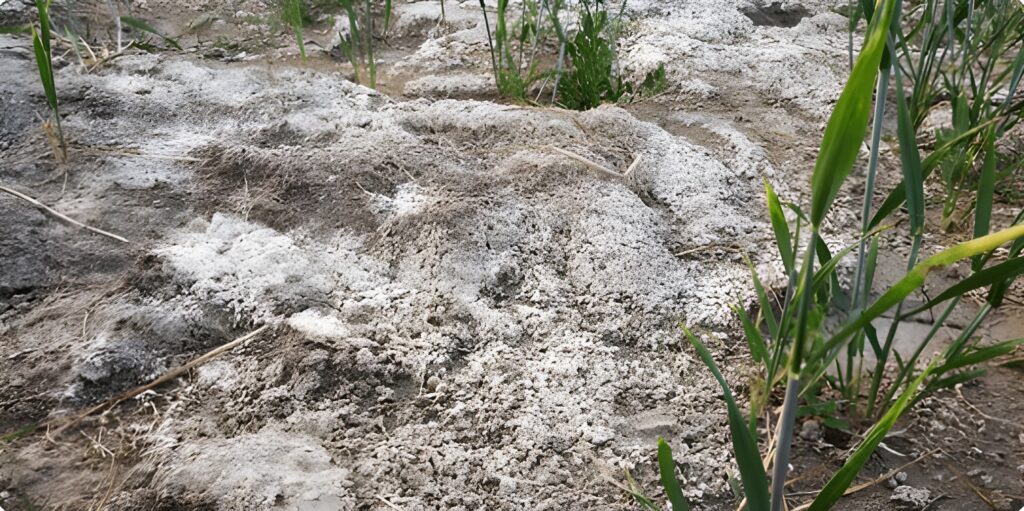
Greetings to all green gold enthusiasts! From Agro Vivero del Mediterráneo, where we have spent years dedicated to the production, cultivation, and management of pistachios, we want to address a crucial topic today that can make the difference between success and failure in your orchards: the management of salinity in irrigation water.
The pistachio tree, that noble and resilient tree that gives us such a precious nut, is known for its remarkable tolerance to adverse conditions. However, this resistance has limits, and one of the most determining and often underestimated factors is the quality of the water with which we nourish it. Salinity, that silent enemy that accumulates in the soil, can seriously compromise the viability and profitability of the orchard if not managed properly and professionally.
Throughout our trajectory, we have accompanied hundreds of farmers in the design, execution, and control of their orchards throughout the Spanish geography. This experience has allowed us to confirm that a deep understanding of the interaction between water, soil, and plant is the cornerstone of any successful pistachio operation. Therefore, in this article, we are going to dive into the complex world of salinity, breaking down its effects, establishing the tolerance thresholds of our trees and, most importantly, sharing the management strategies we have perfected to ensure that your orchards not only survive, but thrive even in challenging water conditions. Join us in this detailed analysis to turn a potential problem into a controlled and manageable variable.
What is Salinity and How Do We Measure It? 🤔
Before delving into thresholds and strategies, it is essential that we all speak the same language. When we refer to “salinity,” we are talking about the total concentration of dissolved mineral salts in the water or in the soil solution. These salts, such as chlorides, sulfates, sodium carbonates, calcium, and magnesium, are natural, but their excess is harmful.
To quantify this parameter, in the agricultural sector we use a key measure: Electrical Conductivity (EC). The logic is simple: the higher the concentration of dissolved salts, the greater the water’s capacity to conduct electricity. EC is commonly expressed in deciSiemens per meter (dS/m) or in equivalent units such as millimhos per centimeter (mmhos/cm).
It is crucial to differentiate between two main measurements:
-
ECw (EC of irrigation water): Measures the salinity of the water we apply directly to our orchards.
-
ECe (EC of the soil saturation extract): Indicates the salinity in the root zone, that is, the real environment where the roots must absorb water and nutrients. This value is the one that truly alerts us to the stress the tree is suffering.
At Agro Vivero del Mediterráneo, we always insist on the importance of carrying out exhaustive analyses of both the soil and the water before even planting the first tree. Knowing these starting values is not an expense, it is the best investment for successful management and to avoid unpleasant surprises in the future.
The Double Negative Impact of Salinity on the Pistachio Tree 🌿💧
High salinity does not affect the plant in a single way, but rather deploys a double attack that diminishes its vigor and productive capacity. Understanding how the pistachio plant reacts at a physiological level is key to anticipating and correcting problems.
-
Osmotic Stress (or “Physiological Thirst”): This is the most immediate and general effect. A high concentration of salts in the soil creates an osmotic potential that makes it extremely difficult for the roots to absorb water. Imagine that the plant is thirsty, but the water in the soil is “held” by the salts with more force than the roots can exert to absorb it. The tree has to spend a much greater amount of energy to hydrate itself, energy that could be allocated to growth, flowering, or nut filling. The visible result is similar to that of a drought: reduced growth, smaller leaves and, in severe cases, wilting, even with moist soil.
-
Specific Ion Toxicity: Beyond the general osmotic effect, certain ions, when they accumulate in excess within the plant tissues, become toxic. For the pistachio tree, the most problematic ions are chloride (Cl⁻), sodium (Na⁺), and boron (B). The plant tries to exclude them at the root level, but this capacity is limited. Over time, especially under conditions of prolonged salinity, these ions overcome the plant’s barriers and are transported with the water to the leaves, where they accumulate to toxic levels. The most characteristic symptom of this toxicity is the appearance of burns or necrosis on the margins and tips of older leaves, which can progress to cause premature defoliation, reducing the tree’s photosynthetic capacity and, therefore, its yield.
Understanding this double mechanism of action is vital for designing effective management strategies, since we must not only worry about the total amount of salts (EC), but also about the specific composition of those salts.
Tolerance Thresholds: How Much Can the Pistachio Tree Withstand? 📊
The pistachio tree is undoubtedly one of the most salinity-tolerant nut trees, surpassed only by the date palm. This characteristic has allowed it to expand through arid and semi-arid zones. However, “tolerant” does not mean “immune.” There are thresholds beyond which yield begins to be affected.
Based on our experience and numerous scientific studies, we can establish the following indicative ranges:
For Irrigation Water (ECw):
-
< 1.5 dS/m: Considered excellent quality water. It imposes no restrictions on pistachio cultivation. Safe and uncomplicated irrigation.
-
1.5 – 3.0 dS/m: Good to moderate quality water. Generally safe, although it requires periodic soil monitoring to avoid progressive salt accumulation.
-
3.0 – 5.0 dS/m: Water with moderate salinity. Here we enter a zone of caution. Careful irrigation management is essential, especially in poorly drained soils. The choice of tolerant rootstocks begins to be crucial.
-
5.0 – 8.0 dS/m: Saline water. Long-term use of this water is risky and may not be sustainable without highly specialized agronomic management. In this range, yield reductions are expected. It is absolutely necessary to apply leaching irrigations and use the most resistant rootstocks.
-
> 8.0 dS/m: Highly saline water. Its use is inadvisable for commercial pistachio production. Although the tree may survive, the stress will be so high that production will be minimal or nil, and the longevity of the orchard will be compromised.
This is the most direct indicator of the stress the plant is suffering.
-
< 2 dS/m: Non-saline soil. Ideal conditions for maximum development.
-
2 – 4 dS/m: Slightly saline soil. Most rootstocks will not show symptoms or yield reduction.
-
4 – 8 dS/m: Moderately saline soil. In this range, the plant begins to suffer stress. The choice of rootstock becomes critical. Research has shown that above 6 dS/m, yield drops begin to be observed. For every dS/m that ECe increases above this threshold, yield can decrease between 1.4% and 3.2%, depending on the rootstock.
-
> 8 dS/m: Strongly saline soil. It is considered the upper limit for a viable crop. Production losses are significant and tree survival is at risk.
It is vital to remember that these thresholds are indicative and can vary depending on factors such as soil type (texture), drainage, climate and, above all, the rootstock used.
The Decisive Role of the Rootstock: Our First Line of Defense 🛡️
At Agro Vivero del Mediterráneo, we consider the choice of rootstock to be the most important and strategic decision a farmer makes when establishing a pistachio orchard. When salinity is a factor to consider, this choice becomes even more critical. Fortunately, we have a range of rootstocks with different degrees of tolerance.
-
Pistacia terebinthus (Cornicabra): It is the native rootstock of the Iberian Peninsula. It shows good adaptation to our soils and remarkable hardiness. It has notable cold tolerance and defends itself well in moderate salinity conditions.
-
Pistacia atlantica: This rootstock is known for its great vigor and drought resistance. It shows good tolerance to salinity, superior in many cases to that of other rootstocks. Some studies have shown that P. atlantica manages sodium and chloride absorption better than other rootstocks.
-
Pistacia integerrima (PGI): Although highly valued for its resistance to the Verticillium dahliae fungus disease, PGI is generally considered the most sensitive to salinity of the commercial rootstocks. Its use in areas with irrigation water over 3.0 dS/m should be evaluated very cautiously.
-
UCB-1 (Hybrid of P. atlantica x P. integerrima): This is undoubtedly the star rootstock today and the most widely used in new orchards, especially under irrigation. UCB-1 combines the Verticillium resistance of P. integerrima with the vigor and tolerance to salinity and cold of P. atlantica. Its greater tolerance to salts is partly due to its ability to effectively exclude sodium (Na⁺) and chloride (Cl⁻) ions at the root level, preventing them from reaching the aerial part in large quantities. In addition, it is capable of sequestering sodium in the vacuoles of root cells, acting as a protective filter. For all these reasons, UCB-1 is our main recommendation for orchards facing moderate to high salinity challenges.
The right choice will not only increase the tree’s chances of survival, but will also keep production levels in profitable ranges, even with lower quality water.
Management Strategies to Combat Salinity: Our Action Plan 👨🌾
Once we know our starting point (water and soil analysis) and have chosen the right rootstock, we must implement a series of agronomic practices designed to mitigate the effects of salinity. It is not a single magic solution, but an integrated and continuous approach.
1. Strategic Irrigation Management
Irrigation is, paradoxically, both the source of the problem and the main tool to solve it.
-
High-Frequency Drip Irrigation: Using localized irrigation systems like drip allows us to maintain a constant moisture zone around the roots (the wet bulb). By applying more frequent and shorter irrigations, we keep the salts dissolved and push them towards the periphery of the bulb, away from the zone of maximum root absorption. This creates a kind of low-salinity “oasis” where the tree can develop.
-
Leaching Fraction: This is the most important technique for controlling soil salinity. It consists of applying an amount of water additional to what the crop needs for its evapotranspiration. This surplus water infiltrates below the root zone, carrying with it the excess accumulated salts. The calculation of the leaching fraction (LF) depends on the EC of the irrigation water (ECw) and the maximum salinity threshold we want to maintain in the soil (ECe).
-
Winter Leaching (Dormant Leaching): The best time to perform intensive leaching is during the winter dormancy period (from November to March). At this time, evapotranspiration is very low, so almost all the applied water is effective for leaching salts. In addition, we take advantage of winter rains, which are usually of very low salinity, to enhance this cleaning effect of the soil profile. Depending on the soil texture and the salt load, between 150 and 250 mm of water or effective rain may be needed for efficient leaching.
2. Improvement of Soil Drainage
It is useless to apply leaching water if the soil is not capable of draining it. Poor drainage causes waterlogging, root asphyxia and, worse still, the concentration of salts on the surface due to evaporation.
-
Soil Texture Analysis: Very clayey soils or those with compacted layers are prone to poor drainage. It is essential to know the structure of our soil.
-
Subsoiling: Before planting, subsoiling work can break compacted layers (plow pan) and drastically improve the vertical infiltration of water.
-
Subsurface Drains: In extreme cases of very heavy soils with severe drainage problems, the installation of a subsurface drainage system may be the only viable solution, although its cost is high.
3. Use of Soil Amendments
Amendments do not eliminate salts by themselves, but they improve soil structure and facilitate their leaching. They are especially important in sodic soils (with excess sodium), which tend to disperse and lose their structure.
-
Agricultural Gypsum (Calcium Sulfate): It is the most widely used and effective amendment. The calcium (Ca²⁺) in gypsum displaces the sodium (Na⁺) attached to the soil clays. This sodium is left free in the soil solution and can be easily washed away (leached) by irrigation water or rain. The application of gypsum is especially recommended before winter leaching.
-
Organic Matter: The addition of well-decomposed compost or manure improves soil structure, creating more stable aggregates that increase porosity and, therefore, infiltration and drainage. A soil with good levels of organic matter is more resilient to salinity.
-
Acidifying Amendments: In soils with high pH and sodium problems, products such as elemental sulfur or calcium polysulfide can help solubilize the calcium present in the soil, which in turn will displace the sodium.
4. Balanced and Careful Fertilization
Salinity interferes with nutrient absorption. High concentrations of Na⁺ and Cl⁻ can compete with the absorption of essential nutrients such as potassium (K⁺), calcium (Ca²⁺), and nitrates (NO₃⁻).
-
Foliar Analysis: It is the key tool to diagnose the real nutritional status of the tree. It allows us to adjust the fertilization plan to correct possible deficiencies induced by salinity.
-
Increase Potassium and Calcium Inputs: Since sodium competes directly with them, it may be necessary to slightly increase K⁺ and Ca²⁺ inputs to ensure that the plant has them available in sufficient quantities.
-
Low Salt Index Fertilizers: We must choose fertilizers that provide the least amount of salts possible. For example, it is preferable to use potassium sulfate instead of potassium chloride, especially in soils with chloride problems.
5. Continuous Monitoring
Salinity management is not a one-time action, but a continuous process of monitoring and adjustment.
-
Annual Analyses: We recommend performing a water analysis at least once a year, and a soil analysis in the root zone every 1-2 years to see the evolution of the ECe.
-
Visual Observation: Constant monitoring of the orchard to detect the first symptoms of toxicity in the leaves (marginal burns) allows us to act quickly before the problem worsens.
Conclusion: Salinity, an Overcomeable Challenge with Knowledge and Technique 🏆
From Agro Vivero del Mediterráneo, we want to convey a message of optimism and empowerment. The pistachio, thanks to its incredible hardiness and the availability of high-tech rootstocks like UCB-1, can be successfully cultivated in salinity conditions that would be prohibitive for other crops.
However, success does not happen by chance. It requires a professional approach, based on analysis, planning, and the execution of well-founded agronomic management strategies. Salinity is not an insurmountable obstacle, but a characteristic of the environment that we must learn to manage.
Starting with a correct choice of rootstock, moving on to an intelligent irrigation design that includes the leaching fraction, and complementing with proper soil and nutrition management, we can create a balanced ecosystem that allows our pistachio trees to express their full productive potential and ensure the profitability of our investment in the long term.
We are entirely at your disposal to accompany you every step of the way. We offer you our complete range of services, from the initial analysis to continuous advice. If you have any questions, do not hesitate to contact our technical team. And if you are already planning your project, you can request a detailed quote through our reservation form.
Together, we will make the green gold shine brighter than ever! ✨🌳