


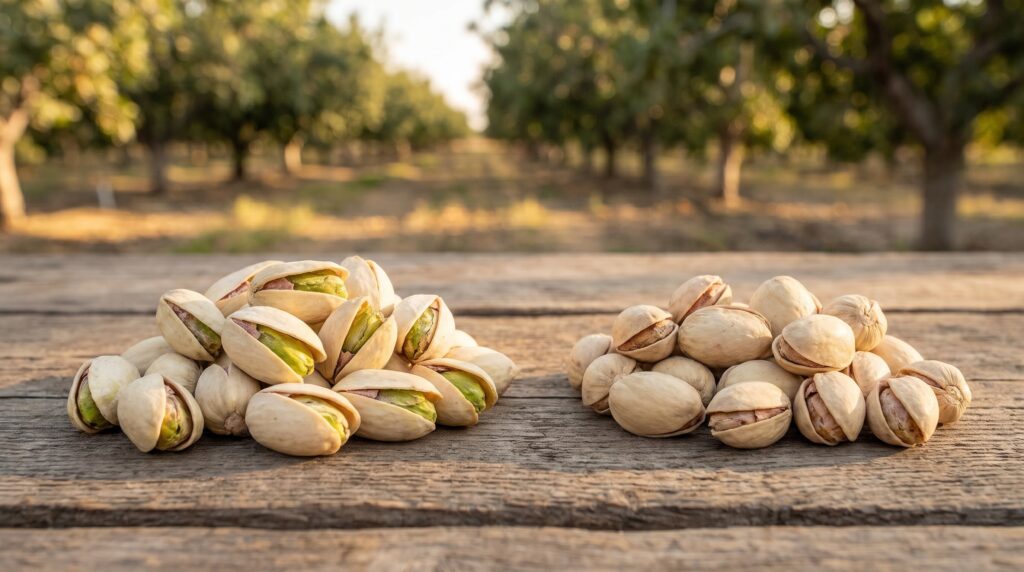
Choosing between Lost Hills vs Kerman is one of the most important decisions when planning a pistachio orchard. It is not a matter of taste. The variety determines when we harvest, how much winter chilling the tree needs, which pollinizer we must plant alongside it and, ultimately, how much we earn per kilogram of pistachio nuts. 🌳
Kerman has long been the benchmark female variety. Lost Hills came out of a University of California breeding program, with the aim of offering an earlier alternative with a larger nut size and a more regular yield. ⚖️
At Agro Vivero del Mediterráneo we receive this question very often. It comes from small growers who want to start with a few hectares and from large operations expanding an orchard that is already up and running. That is why we have prepared this comparative guide, backed by real trials and by what we see every day working alongside the growers who plant with us. By the end, we will know which variety best suits our climate, our water and the way we work. 🌰
Kerman: the pistachio variety that has shaped the industry 🏆
Kerman is the female variety that has dominated pistachio orchards since practically the 1960s. University of California specialists note that, for a long time, Californian producers relied almost entirely on Kerman as the female and Peters as the male. That track record explains why it remains the best-known option among hullers, buyers and processing companies.
What we value most about it:
- 🌰 Pistachio nuts of a quality the market knows very well.
- 📚 Predictable performance, because it has been studied in many regions, soils and irrigation systems.
- ❄️ A good fit for regions with cold winters and a well-defined winter dormancy period.
- 🤝 A benchmark pollinizer, Peters, whose flowering closely matches Kerman’s.
It also has limitations worth knowing before deciding. It ripens late, around mid-September in the California trials, and shows more pronounced alternate bearing. Compared with Lost Hills, it also has a lower percentage of split nuts and more blank nuts.
Lost Hills: the early, larger-nut alternative 🚀
Lost Hills is a female variety released in 2005 by the University of California. It comes from a breeding program that ran between 1989 and 1996, and it was presented as a possible replacement for Kerman. These are its most notable traits according to published trials:
- 📅 Early harvest compared with Kerman.
- 📏 Larger individual nut size and weight.
- 😮 More split nuts and fewer blank nuts.
- 🔁 A more regular yield, with less alternate bearing.
- 🌡️ Lower winter chilling requirement.
That said, it is not a variety without drawbacks. The same trials indicate that ripening can be less uniform on some farms and in cold years. They also indicate that the shell hinge is weaker, which means more lost shells and kernels during harvesting. We look at this in more detail in the sections below.
Lost Hills vs Kerman comparison table 📊
This table sums up the main differences. The data come from University of California trials and its agricultural extension service. Every farm is different, so these figures should be taken as guidance, not as a promise.
| Characteristic | Kerman | Lost Hills |
|---|---|---|
| Winter chilling | More than 750 chill hours | Needs less chilling than Kerman |
| Full bloom | Benchmark (around 12 April in one trial) | About 5 days earlier (around 7 April) |
| Usual pollinizer | Peters | Randy (and Tejon in smaller proportion) |
| Harvest date | Around 15 September in the trial | Around 4 September; 11 to 14 days earlier on average |
| Nut size | Smaller | Larger size and weight |
| Split nuts | Fewer | More |
| Blank nuts | More | Fewer |
| Alternate bearing index | 0.5 | 0.2 |
| Commercial yield | No consistent differences | No consistent differences |
| Loss of shells and kernels | Less than 0.5% | Around 3% |
| Ripening uniformity | Benchmark | Variable depending on farm and year |
Winter chilling: the first filter when choosing a variety ❄️
Pistachio trees need to accumulate cold during winter to break dormancy properly and to bud, flower and set nuts uniformly. According to University of California data, Kerman needs more than 750 chill hours below 7.2 °C, and its pollinizer Peters needs more than 900. Depending on the chill model used and the region, some sources work with slightly different figures. The prudent approach is to check them against a weather station close to the plot.
Lost Hills needs less winter chilling than Kerman. That improves the uniformity of budbreak, flowering, nut set, nut fill and ripening in mild winters, which are the ones that hit Kerman hardest. When chilling is insufficient, the usual symptoms are early drop of newly set nutlets, more blank nuts and poor yields. 🥶
But needing less chilling does not mean not needing it. That is why, before recommending a variety, in our technical advice services we review the temperatures of several winters, not just the last one. With winters becoming increasingly variable, that broader view makes all the difference.
Flowering and pollination: the detail that causes the most mistakes 🌸
The pistachio is a dioecious species. There are female trees, which produce the nuts, and male trees, which only supply pollen. The wind does the rest, so the match between the flowering of females and males is vital for pollination.
Kerman is traditionally pollinated with Peters. Lost Hills, in contrast, flowers about five days earlier than Kerman, and its pollination period coincides with that of Randy, an early-flowering male released in 2005 by the same university. In the Californian trials, Randy (at least 80% of the males) and Tejon (up to 20%) were used.
The practical consequence is clear: we cannot plant Lost Hills next to Peters and expect the same result. As a guideline, we usually reserve around 10–12% of the trees for males, strategically distributed across the plot. 🐝
Flowering earlier has a side effect. It increases exposure to late spring frosts, and in valley areas or places with frequent frosts, earliness can become a problem.
Harvest date: when the calendar makes the difference 🚜
It is the most visible difference between the two pistachio varieties. In University of California trials in the San Joaquin Valley, Lost Hills was ready around 4 September and Kerman around 15 September. Field averages point to an advance of about 11 to 14 days. The university itself puts the advantage at 2 to 4 weeks, depending on location and season.
What does an early harvest bring?
- 🚜 Better distribution of work. With two staggered varieties, the same machinery and crew serve a larger area.
- 🌧️ Less exposure to autumn rain, which promotes diseases in the clusters.
- 🐛 Less damage from end-of-season pests. In California, the earlier harvest of Lost Hills significantly reduced damage from a moth that attacks the nut.
- 🧮 Less pressure on peak days, because the harvest window is wider.
A warning is in order. In cold years or on some farms, the ripening of Lost Hills can be less uniform. Getting ahead does not mean harvesting in a hurry: we need to monitor the optimum point on each plot so as not to lose quality.
Nut size, split nuts and nut quality 🌰
This is where Lost Hills plays strong. The trials agree that its nuts have greater size and individual weight than Kerman’s, more split nuts and fewer blank nuts. This matters for three reasons:
- A larger nut size is more attractive for the in-shell product.
- Split nuts are the ones that sell best.
- Fewer blank nuts mean less useless weight to transport and less waste at the huller.
The trade-off is the shell. In California trials, Lost Hills lost around 3% of shells and kernels, compared with less than 0.5% for Kerman. In practice, mechanical harvesting and post-harvest handling need fine-tuning to limit those losses. It is a point that deserves attention, although it does not invalidate the variety. ⚙️
Alternate bearing: yield regularity 🔄
Pistachio trees tend towards alternate bearing: a year of heavy crop followed by a light one. In Kerman it is very pronounced. University of California specialists measure it with an index in which the closer to 0, the more regular the tree. Kerman shows 0.5, Golden Hills 0.3 and Lost Hills 0.2.
A regular yield makes it easier to plan costs, contracts and cash flow. Let’s take an illustrative example: a 40-hectare farm that alternates heavy- and light-crop years. It has to size machinery and workforce for the peak years, and those resources are underused in the light years. With a regular yield, that investment is spread more evenly. 📈
Yield and profitability: which one delivers more? 💶
It is the question we are asked most often. University of California trials found no consistent differences in commercial yield between Kerman and Lost Hills. Neither wins simply by producing more kilograms. Orchard profitability is decided by other factors:
- Nut size and the percentage of split nuts, which affect the price.
- Losses during harvest.
- Harvesting costs and logistics.
- Climate risk: frost, lack of chilling or rain in the middle of the harvest campaign.
- Year-to-year yield regularity.
To assess orchard profitability, we recommend running the numbers for both scenarios, including risk. Our page on the profitability of a pistachio orchard can serve as a starting point. 🧾
Climate, water and soil: where each variety fits best 💧
Kerman performs well in regions with cold winters, later flowering and lower frost risk. That said, it needs a long, mild autumn to complete ripening. Lost Hills adapts better to mild or variable winters and to autumns in which bringing the harvest forward is an advantage. Some University of California trials also suggest it may be of interest when the tree’s full water demand cannot be met.
The variety is only one part of the whole. Rootstocks, soil quality, irrigation water salinity and plant health weigh as much as it does. A quality pistachio plant, well adapted to the plot, is the foundation of any orchard. 🌿
Which variety suits each type of grower? 👨🌾
These are the situations we come across most often in pistachio orchards of every size:
| Situation | Variety we consider first | Why |
|---|---|---|
| Cold winters and spring frost risk | Kerman | Later flowering and very well-known performance |
| Mild or variable winters | Lost Hills | Less demanding in winter chilling |
| Rainy autumns | Lost Hills | Early harvest reduces exposure to rain |
| Small grower with a few hectares | A single, well-chosen variety | Simplifies management and the pollinizer |
| Large operation | Combine both | Staggers the harvest and spreads risk |
| Contracted machinery | Lost Hills or a mix | May make it easier to find free harvest dates |
This table is a compass, not a verdict. The analysis of each plot can change the answer.
Can we combine Lost Hills and Kerman in the same orchard? 🧩
Yes, and on large farms it is usually a good strategy. By staggering the harvest, we make better use of machinery and reduce the risk of one bad year affecting the entire crop. It must be done properly, though:
- Separate blocks for each variety, so each can be managed according to its own calendar.
- A suitable pollinizer for each block: Peters for Kerman and Randy for Lost Hills.
- Irrigation divided into sectors, to adjust the water to each stage of the cycle.
- An orchard layout planned from the outset, because correcting it later is expensive.
If we are weighing up this option, we can talk to our team and study the farm layout before planting a single tree. 📐
Common mistakes when choosing between Lost Hills and Kerman ⚠️
These are the mistakes we see most often, and they can be avoided:
- Deciding based only on nut size or on earlier harvest.
- Forgetting the right pollinizer for each variety.
- Not reviewing the accumulated chilling of several winters.
- Ignoring the risk of late spring frosts during flowering.
- Buying plants without a guarantee of the variety. Lost Hills is a variety protected by the University of California, so it is important to make sure the plants come from an authorized nursery with the variety guaranteed.
Frequently asked questions about Lost Hills vs Kerman ❓
Does Lost Hills yield more than Kerman?
Not consistently. The trials show no clear differences in commercial yield. Lost Hills stands out for nut size, the percentage of split nuts and regularity.
How many days earlier is Lost Hills harvested?
It depends on the region and the season. In field trials, the average is around 11 to 14 days earlier than Kerman. The university that developed it speaks of 2 to 4 weeks.
Which pollinizer does each one need?
Kerman is pollinated with Peters. Lost Hills is pollinated with Randy, which flowers earlier, and in smaller proportion with Tejon.
Is Lost Hills suitable for low-chill regions?
It needs less winter chilling than Kerman, but it still needs it. We always recommend analyzing the temperature data for the plot before deciding.
Which is better for a small grower?
It depends on the climate and the frost risk. For those starting out, it is usually simpler to work with a single variety and its pollinizer, always well adapted to the area.
Where can we source plants of both varieties?
You can browse our pistachio plants and ask us for advice on the variety that best suits your farm. 🌱
The next step 🌟
There is no universal winner in the Lost Hills vs Kerman comparison. Kerman is the predictable benchmark, with very good performance in cold winters and a market that knows it well. Lost Hills offers early harvest, larger nut size, more split nuts and a more regular yield, in exchange for taking care over the pollinizer, frost risk and harvest losses.
The best pistachio variety will be the one that best fits our climate, our water, our soil and our work calendar. If we want to settle our doubts with someone who knows the crop, at Agro Vivero del Mediterráneo we are here to help you. You can contact us or request a quote directly through our reservation and quote request form. 🌳