


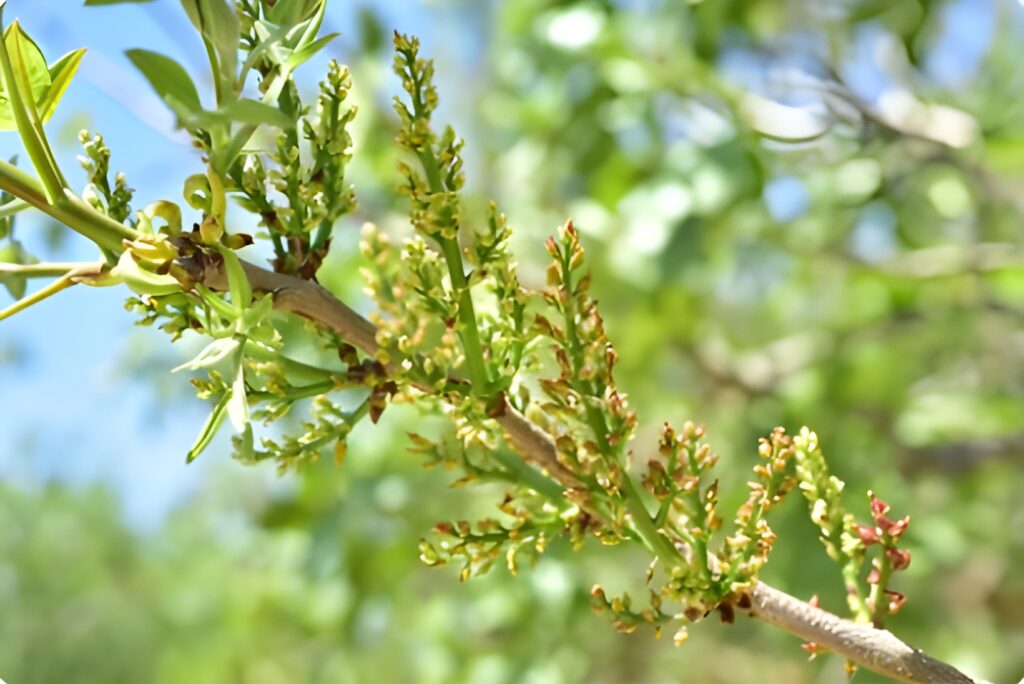
At Agro Vivero del Mediterráneo, we have spent years dedicating ourselves body and soul to the fascinating world of pistachios. Our experience has taught us that the success of an orchard does not only depend on good land preparation or choosing the right pistachio plant, but also on precise agronomic management that pays attention to detail. One of the most critical moments that largely defines the volume of the harvest is, without a doubt, pollination. 🌬️🌸
The pistachio, as we well know, is a dioecious species, which means we have male plants and female plants. The wind (anemophilous pollination) is responsible for transporting the pollen from the male flowers to the female ones so that fertilization occurs and, therefore, the fruit set of the precious nut. In an ideal situation, with a correct distribution of males and females in the orchard and favorable climatic conditions, this natural process is sufficient to guarantee excellent production.
However, nature is capricious. There are years when the male’s flowering does not synchronize properly with the female’s, or it is scarce, or the weather conditions work against us. It is at these times when human intervention becomes not just an option, but a necessity to save the harvest. Today we want to share with you our vision and knowledge about artificial pollination in pistachios, a fundamental tool to ensure the profitability of the orchard even in the most adverse seasons.
When should we consider artificial pollination? Warning signs in our orchard 🧐
Making the decision to carry out supplemental pollination is not something that should be taken lightly. It involves an investment in time and resources, so it is crucial to know how to identify the situations in which it is truly necessary. At Agro Vivero del Mediterráneo, we have identified several key signs and scenarios that indicate that natural pollination may be insufficient:
-
Flowering asynchrony (dichogamy): This is perhaps the most common reason. It may happen that the females are at their optimal point of floral receptivity (full bloom) and the males have not yet begun to release pollen, or vice versa, that the males release their pollen before the females are ready. This lack of synchrony, which can be several days, causes a large part of the female flowers not to be fertilized. This is especially critical in young orchards, where pollen production is still limited, or in years with anomalous springs, with sudden temperature changes that alter the flowering cycles of each sex.
-
Scarce or zero male flowering: There are years when, for various reasons (water stress from the previous year, phytosanitary problems, pronounced alternate bearing, late frost damage to male flower buds…), the males produce very few inflorescences. If, when inspecting our male trees, we observe a visibly lower amount of flowers than usual, we must sound the alarm. A low pollen load in the environment will inevitably translate into a low fruit set percentage.
-
Adverse weather conditions during flowering: Anemophilous pollination depends 100% on the weather. Persistent rains during the key days of flowering are the worst enemy of the pistachio tree. Rain not only washes the pollen from the anthers and the environment, preventing it from flying, but it can also damage the female flowers and hinder stigma receptivity. Similarly, periods of total calm, with no wind at all, are also detrimental, as the pollen is not effectively dispersed throughout the orchard. High relative humidity also clumps the pollen, making it difficult to transport.
-
Poor orchard design: In older or poorly planned orchards, it is possible to find an inadequate proportion of males and females (the ideal is 8-12% males) or an incorrect distribution of them. Males must be strategically distributed so that the wind can carry their pollen to all females. If we have areas of the farm with a low density of pollinators, those areas will be perfect candidates to receive artificial support.
-
Young orchards: During the first productive years, although the trees already produce flowers, the amount of pollen produced by a young male is considerably less than that of an adult tree. At this stage, reinforcement pollination can make the difference between a token first harvest and an already interesting production, accelerating the project’s entry into profitability.
Evaluating these factors together will give us the definitive clue. Direct observation in the field is our best tool. Walking through the orchard, looking at the state of the male and female flowers, and keeping a close eye on the weather forecast are indispensable tasks in spring.
Pollen collection and preservation: The gold dust of our orchard ✨
Before talking about application techniques, it is essential to understand the previous step: obtaining and handling pollen. Without quality pollen, any effort will be in vain. This process is delicate and requires meticulous planning.
1. When and how to collect male flowers?
The optimal time to cut the male inflorescences (flower clusters) is just before the anthers begin to open and release pollen massively. This state is known as “pre-anthesis”. How to identify it? Male flowers change from a greenish color to a more yellowish or reddish tone (depending on the male variety). If, when gently tapping an inflorescence, we see that it already releases a small cloud of pollen, it is the perfect time.
Collection is done manually, cutting the clusters with pruning shears and placing them very carefully in boxes or trays. It is important not to compact them to avoid damage and promote aeration. We can collect pollen from the males on our own farm or, if we foresee a shortage, from other orchards that have an earlier or more abundant flowering. It is even a common practice to collect pollen from an earlier male variety to pollinate a female variety that is also early.
2. The drying and extraction process
Once the inflorescences are collected, we must take them to a closed, dry, ventilated, and dark place to proceed with pollen extraction. A well-conditioned room or a small greenhouse can serve.
-
We spread kraft paper or very fine meshes on a flat surface.
-
We place the inflorescences on top, in a single layer, without piling them up.
-
As the flowers dry at room temperature (ideally between 20-25 °C), the anthers will open (dehiscence) and release the pollen, which will fall onto the paper or mesh. This process usually takes between 24 and 72 hours.
-
To accelerate and maximize release, we can gently tap the dry inflorescences over the collection surface.
3. Sieving and purification
The collected pollen will be mixed with remains of anthers, petals, and other plant detritus. To ensure a homogeneous application and avoid problems in the dusting machinery, it is essential to clean it. This is done through a sieving or screening process, using sieves or screens with a very fine mesh size (between 100 and 150 microns) that allow the tiny pollen grain to pass through but retain larger impurities. The result should be a very fine, yellowish powder with a homogeneous appearance.
4. Pollen preservation: Ensuring viability
Pistachio pollen is a living organism and its viability (its ability to germinate and fertilize) decreases over time if not properly preserved. Humidity and high temperatures are its main enemies.
-
Short-term preservation (days): If we are going to use the pollen in the days following its collection, we can store it in an airtight container in the refrigerator, at a temperature of about 4 °C. It is crucial to ensure that the container is completely dry and that the pollen has a low moisture content (less than 10%) before storing it.
-
Long-term preservation (months or even years): To save pollen from one season to the next (an excellent strategy to mitigate male alternate bearing), freezing is the most effective method. The pollen, once well dried and cleaned, is placed in airtight containers and frozen at -20 °C. In this way, it can maintain a high percentage of viability for more than a year. Before using frozen pollen, it is very important to carry out a slow and progressive thawing process to avoid condensation damage. Ideally, move it from the freezer to the refrigerator 24 hours beforehand, and from the refrigerator to room temperature a few hours before use.
At Agro Vivero del Mediterráneo we always recommend to farmers who ask us for advice through our services that, if possible, they create their own pollen bank. Collecting and freezing pollen in years of good male flowering is an insurance policy for bad years.
Artificial pollination techniques: How do we apply the pollen? 💨
Once we have our pollen ready, the crucial moment arrives to distribute it throughout the orchard. The key is to do it when the highest percentage of female flowers is receptive. This period of maximum receptivity usually lasts between 3 and 5 days. The application should be done in conditions of low relative humidity and, preferably, with a light breeze that helps distribute the pollen. Early morning hours, once the dew has evaporated, are usually the best time.
There are different methods for carrying out artificial pollination, from the most manual and simple to the most highly technical. The choice will depend on the size of the orchard, the available means, and the urgency of the situation.
Dry dusting method 🌬️
This is the most widespread technique and, in general, the most efficient for orchards of a certain size. It consists of distributing the pollen in powder form directly over the canopies of the female trees.
-
Mixing with inert carriers: Pure pollen is extremely fine and volatile, and the amount needed per hectare is relatively small (between 500 and 1,000 grams of pure pollen). To facilitate its homogeneous distribution and increase the volume of product to be applied, it is usually mixed with an inert, dry material of similar particle size. The most commonly used are toasted flour, lycopodium, milk powder, or even specific talcs. The proportion of the mixture can vary, but ratios of 1:5 to 1:10 (one part pollen to five or ten parts carrier) are usually used. It is vital that the mixture is very homogeneous.
-
Application equipment:
-
Motorized blowers/dusters: They are the most common tool. These are backpack machines, similar to those used for powder phytosanitary treatments, but adapted for this purpose. The operator walks through the rows of the orchard directing the air stream with the pollen mixture towards the canopies of the female trees. It is important to regulate the air flow well to create a cloud that envelops the trees without being so violent that it damages the flowers.
-
Tractor-mounted equipment: For large areas, there is larger equipment that attaches to the tractor. They are usually high-power atomizers or nebulizers that allow treating several rows at once, greatly speeding up the work.
-
Drones and light aircraft: In the most advanced precision agriculture, drones equipped with powder dispensers are already being used to carry out pollination. This technology allows a very precise and fast application, especially in hard-to-reach terrain. Although its cost is higher, it can be a very interesting option to consider.
-
To maximize the effectiveness of dry dusting, we recommend making two or even three passes on alternate days during the peak of female flowering, to ensure that we reach all the flowers as they become receptive.
Wet spraying method 💧
This technique consists of mixing the pollen in an aqueous solution and spraying it on the trees. Although it may seem easier to apply with conventional phytosanitary treatment equipment, it presents certain complexities and, in our experience, its effectiveness can be more variable than that of the dry method.
-
Preparation of the solution: The pollen is suspended in water, to which a sucrose (common sugar) buffer is added in a concentration of between 10% and 20%. This sugary solution creates an osmotically favorable medium that helps maintain pollen viability and favors its germination on the flower stigma. The pollen dose is usually similar to that of the dry method, about 500-1,000 grams per hectare, dissolved in the necessary spray volume to adequately wet the leaf surface (normally between 500 and 1,000 liters/ha).
-
Application: Conventional sprayers or atomizers (guns, turbos, etc.) are used. It is essential that the equipment is perfectly clean, without phytosanitary residues that could damage the pollen. The application must be a very fine mist, which wets the flowers without reaching the point of runoff, as excess water could damage the pollen.
-
Advantages and disadvantages: The main advantage is that equipment that most farmers already own can be used. However, pollen loses viability very quickly in contact with water, so the mixture must be prepared right at the time of application and used within a few hours. Furthermore, the effectiveness of this method is more controversial and seems to be lower than that of dry dusting in many conditions. Rain after treatment can completely wash away the application.
Manual and localized methods 👋
For very small orchards, isolated trees, or for very specific situations, there are more artisanal methods.
-
The “pollinator bouquet”: It consists of cutting branches with male flowers in pre-anthesis and hanging them on the branches of the female trees, oriented downwind. It is a simple method but of limited effectiveness and requires a large number of male flowers.
-
Application with a brush: It is an extremely laborious method, only viable for pollinating a few flowers in a genetic improvement program or in a private garden. It consists of collecting pollen with a soft brush and applying it directly, one by one, to the receptive female flowers.
Final considerations for successful artificial pollination ✅
To close the circle and ensure that our investment in artificial pollination bears fruit (nuts), there are some additional aspects that we at Agro Vivero del Mediterráneo always emphasize:
-
Application timing: It is the most critical factor. We must identify the moment of maximum receptivity of the majority of the female flowers. This is observed visually: the flower stigmas are turgid, brightly colored, and sometimes secrete a small droplet of nectar. Applying before or after this peak will drastically reduce effectiveness.
-
Environmental conditions: As we have mentioned, applying on a rainy day or with a relative humidity above 70-80% is counterproductive. Ideally, a sunny, dry day with a gentle breeze.
-
Pollen viability: Before making a large-scale application, especially if we use stored pollen from the previous year, it is highly recommended to do a viability test. It can be done simply in the laboratory or even with homemade methods, preparing it in a Petri dish with an agar and sugar solution and observing under a microscope if the pollen grains germinate and emit the pollen tube. This will give us the certainty that we are working with quality material. If you need more information on how to perform these tests, do not hesitate to contact our technical team.
-
Pollination as a comprehensive service: The success of a pistachio orchard is not based on isolated actions, but on a global approach. Pollination, whether natural or artificial, is just one more piece of a puzzle that includes plant choice, irrigation, nutrition, pruning, and pest control. All these factors are interconnected. A well-nourished and stress-free tree will produce higher quality and more receptive flowers. Therefore, we offer comprehensive advice covering all phases of cultivation.
The path to an abundant and quality pistachio harvest is full of challenges, and the variables we cannot control, such as the weather, will always be there. However, technology and agronomic knowledge provide us with increasingly effective tools to mitigate risks. Artificial pollination is undoubtedly one of the most valuable. It is not about replacing nature, but about lending a hand when it needs it most, ensuring the work and investment of a whole year.
At Agro Vivero del Mediterráneo we are convinced that a well-informed farmer is a successful farmer. We hope this detailed guide on artificial pollination is of great use to you. If you are thinking of starting a new orchard or want to optimize the one you already have, we invite you to fill out our reservation and quote form so that we can study your case in a personalized way and offer you the best solutions. Together, we can make every season a success. 💚