


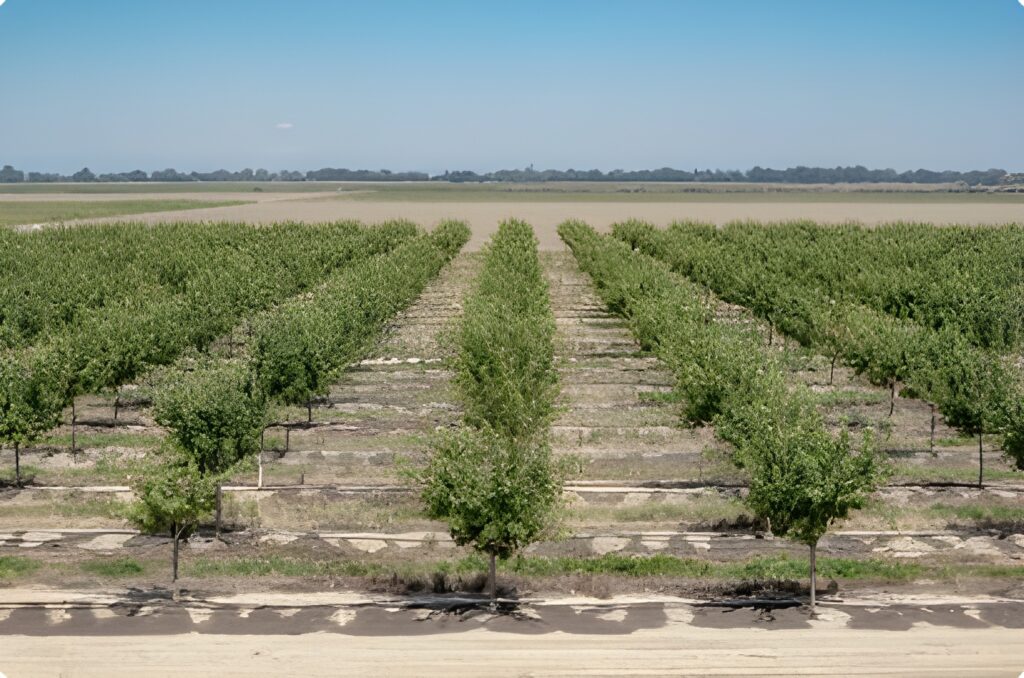
At Agro Vivero del Mediterráneo, with our extensive experience in the pistachio sector, we understand that every decision made in the plantation is a fundamental pillar for the future success of the harvest. One of the most critical decisions and one that generates the most debate among professionals in the sector is, without a doubt, the choice of irrigation system. The pistachio tree, despite its well-earned reputation as a drought-resistant tree, needs precise and strategic water management to deploy its full productive potential. An adequate water supply not only guarantees the survival of the tree, but also boosts its growth, increases the percentage of nut filling, improves its caliber and, ultimately, maximizes the profitability of the farm.
Today, from our experience, we want to address an exhaustive comparison between two of the most widespread and efficient localized irrigation systems: drip irrigation and micro-sprinkler irrigation. Both methods have proven their worth in the field, but present substantial differences in terms of operation, costs, management, and adaptation to the specific conditions of each plantation. The objective of this article is to break down each of these systems, analyzing their advantages and disadvantages applied to pistachio cultivation, so that you, as farmers, can make the most informed and correct decision for your project. Join us in this detailed analysis! 💧🌳
Drip Irrigation: Precision as a Flag
Drip irrigation is, today, the most recommended and used system in modern pistachio plantations, and it is not by chance. Its fundamental principle is the slow and precise application of water directly over the influence zone of the tree’s root system, drop by drop. This localized application offers a series of advantages that make it a formidable ally for the efficient management of such a valuable resource as water.
Advantages of Drip Irrigation in Pistachio
-
Maximum Water Efficiency: The main virtue of drip irrigation is its extraordinary efficiency in water use, which can reach and even exceed 90%. By applying water directly to the soil, next to the tree, losses due to evaporation and surface runoff are drastically minimized. In a context of increasing water scarcity and rising energy costs, this water saving translates directly into economic savings and greater plantation sustainability.
-
Improved Phytosanitary Control: One of the great battles in pistachio cultivation is the prevention of fungal diseases, many of which proliferate in high humidity conditions. Drip irrigation keeps the trunk, branches, and foliage of the tree completely dry, creating a much less conducive environment for the development of pathogens such as Botryosphaeria. By not wetting the aerial part of the plant, the incidence of these diseases is significantly reduced, which in turn decreases the need for phytosanitary treatments.
-
High Precision Fertigation: This system is the perfect vehicle for fertigation. It allows applying nutrients dissolved in irrigation water in a fractionated and localized manner, right where the plant needs them: in its root system. This ensures maximum utilization of fertilizers, reduces losses due to leaching (washing of nutrients out of root reach) and allows adjusting the fertilization plan to the specific needs of the tree in each phase of its development (bud break, flowering, nut filling, etc.).
-
Weed Reduction: By moistening only a limited strip of land, the proliferation of weeds in the plantation lanes is considerably reduced. This decreases competition for water and nutrients, and reduces costs associated with weed control, whether by tillage or herbicide use.
-
Adaptability to Complex Terrain: Drip irrigation adapts exceptionally well to land with steep slopes or irregular topography, where other systems such as flooding would be unfeasible. Thanks to pressure-compensating drippers, it is possible to ensure a uniform irrigation flow in each tree, regardless of its position in the plot and pressure variations in the network.
-
Automation and Labor Savings: Drip systems are easily automated using programmers, solenoid valves, and moisture sensors. This allows precise control of irrigation times and frequencies, further optimizing water use and significantly reducing the need for labor for irrigation tasks.
Disadvantages and Considerations of Drip Irrigation
Despite its multiple benefits, the drip system is not without certain drawbacks that we must know and manage properly.
-
Initial Investment: Generally, the installation cost of a drip irrigation system per hectare is usually higher than that of other systems such as micro-sprinkler irrigation. This cost includes not only pipes and drippers, but also a more demanding filtration head, fundamental for its correct operation. We estimate that the installation can range between 2,000 and 5,000 euros per hectare.
-
Clogging Risk: Drippers, due to their small outlet orifices, are susceptible to clogging by sand, silt, clay particles or by salt and organic matter precipitates. This requires a robust filtration system and periodic maintenance that includes filter cleaning and, occasionally, treatments with acids or specific products to prevent and solve obstructions.
-
Potentially Limited Root Development: If the system is not designed and managed correctly, it could concentrate root development in a very localized area (the wetted bulb). To avoid this, it is crucial to adapt the number of drippers and their arrangement as the tree grows. In the first years, one or two drippers per plant may be sufficient, but as the tree develops, it is essential to add more drip lines and separate them from the trunk to encourage the root system to explore a larger volume of soil.
-
Sensitivity to Salinity: Although drip irrigation helps manage salinity by maintaining a constant wet zone and displacing salts towards the periphery of the bulb, poor management or high salinity water can cause harmful accumulations at the edges of the wetted area. It is vital to monitor water quality.
Micro-Sprinkler Irrigation: A Fine and Localized Rain
The micro-sprinkler system is situated at an intermediate point between drip irrigation and conventional sprinkler irrigation. It uses emitters called micro-sprinklers that distribute water in the form of a fine rain over a circular or oval surface around the tree. Although its use in pistachio is less widespread than drip, it presents certain characteristics that make it an interesting option in certain circumstances.
Advantages of Micro-Sprinkler Irrigation in Pistachio
-
Larger Volume of Wetted Soil: The main advantage of micro-sprinkler irrigation is that it moistens a considerably larger soil surface than drip irrigation. This can be beneficial, especially in young plantations or in very sandy soils with a high infiltration rate, as it promotes more expansive and horizontal root development from the beginning.
-
Lower Clogging Risk: Micro-sprinklers have larger outlet orifices than drippers, making them less prone to clogging. This can slightly simplify filtration requirements and maintenance tasks compared to drip.
-
Frost Control (Limited Effect): Under certain conditions, micro-sprinkler irrigation can offer a limited degree of protection against spring frosts by irradiation. By wetting the soil, it accumulates more heat during the day and releases it more slowly at night, potentially slightly increasing the temperature at ground level. In addition, water freezing on plant parts releases latent heat, although this is a technique that requires very specific management and a constant water supply throughout the frost event.
-
Potentially Lower Installation Cost: In some cases, the initial cost of a micro-sprinkler system may be somewhat lower than that of a drip system, although this difference varies greatly depending on the design and components chosen.
Disadvantages and Considerations of Micro-Sprinkler Irrigation
Despite its strengths, micro-sprinkler irrigation presents significant drawbacks that have limited its massive adoption in pistachio cultivation.
-
Lower Water Efficiency: The efficiency of micro-sprinkler irrigation, although superior to conventional sprinkler irrigation, is lower than that of drip. By applying water sprayed through the air, a part is lost by evaporation even before reaching the ground, especially on hot and windy days. Drift losses can also occur if the wind carries small droplets out of the desired area.
-
Higher Disease Risk: This is, perhaps, the biggest drawback for pistachio. Micro-sprinkler irrigation inevitably wets the lower part of the trunk and, depending on the emitter range, can moisten lower leaves and branches. This excess moisture creates ideal conditions for the proliferation of fungal diseases of the collar and aerial system, such as Phytophthora or Alternaria.
-
Favors Weed Appearance: By wetting a wider soil surface, micro-sprinkler irrigation stimulates greater germination and growth of weeds around the tree, increasing competition and control costs.
-
Soil Compaction: The constant impact of water droplets, although small, can cause some compaction in the soil surface layer, especially in soils with high silt or clay content. This can hinder water infiltration in the long term.
-
Interference with Agricultural Tasks: Micro-sprinklers, being elevated above the ground by a stake, can interfere with certain mechanized tasks such as mowing cover crops, herbicide application, or harvesting.
Direct Comparison: Drip vs. Micro-Sprinkler in Pistachio
To facilitate decision making, we have prepared a comparative table summarizing the key points analyzed:
| Feature | Drip Irrigation | Micro-Sprinkler Irrigation |
| Water Efficiency | Very High (>90%) 💧💧💧 | High (80-90%) 💧💧 |
| Disease Control | Excellent (keeps plant dry) ✅✅✅ | Poor (wets trunk/foliage) ❌ |
| Fertigation | Very precise and efficient ✅✅✅ | Less precise, drift risk ✅ |
| Weed Control | Good (limited wetted surface) ✅✅ | Fair (larger wetted surface) ⚠️ |
| Root Development | Requires good management to expand it ✅ | Favors horizontal expansion ✅✅ |
| Adaptability to Terrain | Excellent (ideal for slopes) ✅✅✅ | Good ✅ |
| Investment Cost | Moderate to High 💰💰 | Moderate 💰 |
| Maintenance | Demanding (clogging risk) ⚠️⚠️ | Less demanding (less clogging) ✅ |
| Wind Influence | Null or very low ✅✅✅ | High (drift losses) ❌ |
| Recommendation for Pistachio | Highly Recommended 👍 | Not Recommended/Situational 🤔 |
Factors to Consider for a Wise Choice
From Agro Vivero del Mediterráneo, our general recommendation for pistachio cultivation clearly leans towards drip irrigation. However, we understand that the final decision must be based on a detailed analysis of the specific characteristics of each farm. Below, we detail the key factors to weigh:
-
Soil Type: It is a determining factor.
-
Clay or Loam Soils: These soils have good water retention capacity and allow good lateral expansion of the wetted bulb. Drip irrigation works perfectly, allowing more spaced and deeper irrigations.
-
Sandy Soils: Have low water retention and high vertical infiltration. In these cases, drip is still the best option, but requires a specific design with lower flow drippers and higher irrigation frequency to avoid deep percolation. Micro-sprinkler irrigation might seem like an alternative to wet more surface, but the high efficiency of drip and disease control remain insurmountable advantages.
-
-
Water Quality: It is essential to perform an irrigation water analysis.
-
Water with Suspended Solids: If water contains sand, silt, or organic matter, a drip system will require a high-quality filtration head (sand, mesh, or disc filters) and rigorous maintenance to avoid clogging. Micro-sprinkler irrigation is somewhat more tolerant, but good filtration is always recommended.
-
High Salinity Water: Drip irrigation, with proper management including leaching irrigations, is more effective in controlling salinity in the root zone. Micro-sprinkler irrigation, by wetting leaves, could cause burns due to salt deposition on foliage.
-
-
Area Climatology:
-
Windy Areas: In areas with frequent or strong winds, micro-sprinkler irrigation suffers significant efficiency losses due to drift, distributing water unevenly. Drip irrigation is not affected by wind, guaranteeing uniform application.
-
Ambient Humidity: In regions with high relative ambient humidity, the risk of fungal diseases skyrockets. In these scenarios, the use of micro-sprinkler irrigation is totally inadvisable, with drip irrigation being the only safe option to maintain plantation health.
-
-
Water Availability and Energy Costs:
-
If water allocation is limited or the cost of water and/or energy for pumping is high, the maximum efficiency of drip irrigation becomes a decisive economic factor. Every cubic meter of water saved is a direct benefit for farm profitability.
-
-
Plantation Age:
-
Young Plantations: The goal is to ensure good rooting and rapid tree development. A well-designed drip system, which adapts to tree growth (adding and separating drip lines), is the best strategy to build a powerful and deep root system.
-
Adult Plantations: In full production, water needs are greater, especially during the nut filling phase. A drip system with multiple lines per tree row ensures coverage of an already extended root system and allows applying water and nutrients with maximum precision to obtain a quality harvest.
-
Conclusion: Our Recommendation as Experts
After analyzing both systems in depth, at Agro Vivero del Mediterráneo we have no doubts: drip irrigation is the system of choice for pistachio cultivation in the vast majority of situations. Its unmatched efficiency in water use, superior control of fungal diseases by keeping the plant dry, and the possibility of performing high-precision fertigation, are agronomic and economic advantages of overwhelming weight.
While micro-sprinkler irrigation may have a niche in very specific conditions (extremely sandy soils and no fungal problems), its disadvantages, especially increased phytosanitary risk and lower water efficiency, make it a much riskier and, in the long term, less profitable option for a high-value crop like pistachio.
The initial investment in a good drip system, including an adequate filtration head and professional agronomic design, should not be seen as an expense, but as the best investment to guarantee the sustainability, health, and maximum productivity of your pistachio plantation for years to come. 📈
Let us always remember that success in modern agriculture lies in precision and efficiency. And in pistachio irrigation, precision has a clear name: drip. We are at your entire disposal to advise you on the design and implementation of the system that best suits your project, ensuring that every drop of water is transformed into the precious “green gold”.