


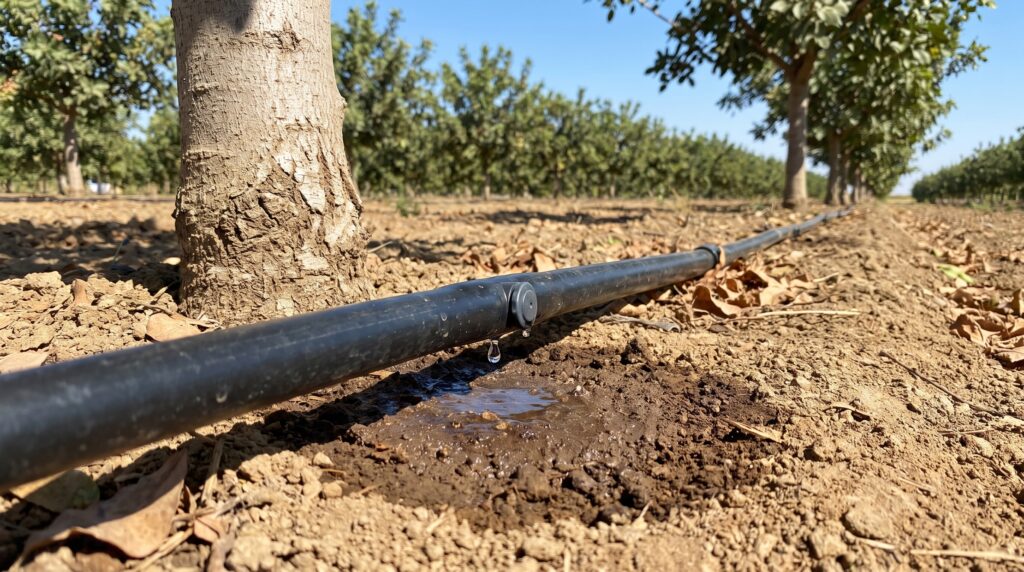
If we are planning a pistachio plantation or want to fine-tune the one we already have, one of the questions we hear most often is how to organise irrigation throughout the year. A pistachio irrigation schedule is not about spreading water evenly every week. It is about giving each stage of the cycle what it needs and saving the cutbacks for the moments when the tree tolerates them best.
At Agro Vivero del Mediterráneo, we support small and large growers in setting up and managing their plantations. One of the lessons we repeat most is that well-scheduled water performs better than abundant water. 🌳
In this guide we go through pistachio irrigation month by month, with indicative volumes, criteria for adjusting them and the mistakes we see most often in the field.
Why a Pistachio Irrigation Calendar Matters 📅
The pistachio is a hardy crop, and it is often assumed that it “can handle anything”. It is true that it withstands drought better than other woody species. But surviving is not the same as producing. If we want consistent harvests, quality nuts and a long-lived plantation, we need a plan.
An irrigation calendar allows us to:
- Apply water when the tree uses it best.
- Avoid excess, which causes root asphyxia and favours disease.
- Take advantage of the tree’s tolerance to water stress during the stage in which it does not penalise production.
- Plan energy use, water-user association turns and costs.
- Reduce alternate bearing, the swing between years of heavy and light crops.
With a little method, irrigated pistachio is one of the woody crops that best turns every cubic metre of water into profitability. If you would like to see how water fits into the overall numbers, you can read our analysis of the profitability of a pistachio plantation.
How Pistachio Water Requirements Are Calculated 🧮
Before moving on to the calendar, it helps to understand where the figures come from. Pistachio water requirements are calculated from two concepts:
- Reference evapotranspiration (ETo): the water lost by a reference surface through evaporation and transpiration. It is published by the agroclimatic stations of each area.
- Crop coefficient (Kc): a factor that adapts that reference to the species and its stage in the cycle. In pistachio it is low at the end of winter and reaches its maximum in midsummer.
The formula is simple: ETc = ETo × Kc. From that result we subtract effective rainfall and adjust for the efficiency of the irrigation system. With a well-designed drip system, we are talking about efficiencies above 90%.
Actual values depend on several factors:
- Local climate and the specific year.
- Age and size of the trees.
- Planting layout and canopy cover.
- Soil type and depth.
- Water quality.
- Rootstock used.
That is why we insist that the figures in this guide are indicative. They are a starting point, not a closed recipe. For a specific plantation, our team can help you through our advisory services.
How Much Water Does a Pistachio Tree Need by Age? 🌱
A young tree has little leaf area and a limited root system. A mature tree in full production transpires far more. This table shows typical ranges in drip-irrigated plantations in inland Mediterranean climates:
| Plantation age | Indicative annual volume (m³/ha) | Notes |
|---|---|---|
| Planting year (1st) | 800 – 1,500 | Frequent, short irrigations to establish the plant |
| 2nd and 3rd year | 1,500 – 2,500 | Priority: training and canopy development |
| 4th to 6th year | 2,500 – 3,500 | Start of production; irrigation begins to be modulated |
| Mature plantation (7 years or more) | 3,000 – 4,500 | Peak demand, with controlled deficit irrigation |
In terms of litres per tree, a mature pistachio in midsummer can receive between 100 and 180 litres per day, depending on planting layout, climate and irrigation strategy. In the first years the figures are much lower.
Starting with a good pistachio plant with a healthy root system and a suitable rootstock makes water management much easier from day one. In our pistachio plant catalogue you will find the options available for each area.
Month-by-Month Pistachio Irrigation Calendar at a Glance 🗓️
Before going into detail, this table summarises the schedule for a mature plantation under irrigation. The volumes are monthly and indicative:
| Month | Crop stage | Irrigation strategy | Indicative volume (m³/ha) |
|---|---|---|---|
| December – February | Winter dormancy | No irrigation unless extreme drought | 0 |
| March | Bud swell | Supplementary irrigation if the soil is dry | 0 – 100 |
| April | Budbreak and flowering | Restore soil moisture | 150 – 250 |
| May | Fruit set and fruit growth | Full irrigation | 400 – 600 |
| June | Shell hardening | Controlled deficit irrigation | 450 – 650 |
| July | Kernel filling | Full irrigation | 600 – 800 |
| August | Kernel filling and ripening | Full irrigation, reducing as harvest approaches | 600 – 750 |
| September | Harvest and post-harvest | Gradual reduction and irrigation after harvest | 300 – 450 |
| October | Post-harvest | Replenishment irrigation | 150 – 300 |
| November | Leaf fall | One closing irrigation if necessary | 0 – 100 |
Adding up the ranges, the annual total comes to roughly 2,700 to 4,000 m³/ha, provided rainfall is favourable and management is well adjusted.
December, January and February: Winter Dormancy ❄️
During winter the pistachio loses its leaves and enters dormancy. Water consumption is practically zero and, except in an exceptionally dry winter, we do not irrigate.
We use these months for tasks that shape the whole season:
- Inspecting the irrigation system: emitters, filters, pipes and valves.
- Cleaning and maintaining the pump station.
- Analysing the water and soil.
- Planning fertilisation and the calendar for the year.
Good winter rainfall refills the soil profile and is the best reserve to start the season with. If the winter has been very dry, a deep irrigation at the end of February can be a good idea.
March: The Plantation Wakes Up 🌤️
As temperatures rise, the buds swell and the plantation comes out of dormancy. Demand is still low, but the soil must hold enough moisture in the root zone.
Our usual approach is:
- If the soil profile is moist after the rains, we do not irrigate.
- If spring starts dry, we apply a supplementary irrigation, deep and widely spaced.
- We avoid waterlogging: the roots are still barely active and cold soil favours asphyxia.
It is a good time to check that the emitters work properly before real demand begins.
April: Budbreak and Pistachio Irrigation During Flowering 🌸
Pistachio irrigation during flowering requires care. The tree breaks bud, the inflorescences appear, and pollination and fruit set take place. Strong water stress at this point can reduce fruit set, but excess water does not help either.
We recommend:
- Starting regular irrigation with moderate volumes.
- Keeping the soil moist without saturating it.
- Avoiding sprinkler irrigation over the canopy, which can harm pollination.
- Adjusting to spring rainfall, which is usually significant in April.
With drip irrigation, two or three short irrigations per week usually work well. This month is a good opportunity for the first fertigation, always coordinated with the nutrition plan.
May: Fruit Set and Fruit Growth 🌿
In May the fruit grows very quickly, especially its outer hull. Temperatures rise and demand soars. This is a sensitive stage and the tree needs water to sustain fruit set and final size.
Here we apply full irrigation, meaning we cover 100% of the estimated ETc:
- More frequent and longer irrigations than in April.
- Weekly monitoring of soil moisture.
- Attention to vegetative development: vigorous shoots and turgid leaves.
A common mistake is to start full irrigation late because of trust in the crop’s hardiness. What is saved in May is usually lost in nut size and yield.
June: Shell Hardening and Controlled Deficit Irrigation ⚖️
Between the end of May and the beginning of July, the shell hardens. This is the stage in which the pistachio best tolerates a water cutback without losing production, because the kernel is not yet filling.
This is the basis of controlled deficit irrigation. We reduce the dose, for example to between 50% and 70% of ETc, for a few specific weeks. The benefits are clear:
- Significant water savings, especially valuable in areas with restrictions.
- Lower vegetative vigour and less pruning required.
- Better control of canopy disease risk.
But there are two conditions. First, apply it only in that window, never before or after. Second, check the tree’s water status with objective tools, such as the pressure chamber, so we do not overdo it. Stress that is too intense or prolonged does penalise the harvest.
July: Kernel Filling, the Decisive Month ☀️
Once shell hardening is complete, kernel filling begins. This is when the weight of the nut and the percentage of split nuts are determined. It also coincides with the highest temperatures of the year.
Summer pistachio irrigation is the main focus here:
- We return to full irrigation, covering 100% of ETc.
- We irrigate frequently, for example daily or on alternate days with drip.
- We avoid the middle hours of the day when the system and the water schedule allow it.
- We check that all emitters work and that there are no blockages.
An irrigation failure at this stage is paid for at harvest. That is why we recommend checking pressures and flow rates regularly, and having a backup plan in case a pump fails or the supply is cut.
August: Final Stretch of Kernel Filling and Ripening 🌰
At the beginning of August kernel filling continues, and towards the end of the month the nuts ripen and harvest approaches. We maintain full irrigation in the first half of the month and begin to reduce gradually as harvest nears.
Several factors should be kept in mind here:
- Excess water close to harvest can favour irregular nut splitting and health problems.
- An abrupt cut-off can cause stress and quality losses.
- Harvest date depends on the variety and the area, so we adjust to the real calendar of each plantation.
If we want to review the best way to approach the season, our team can guide us through the contact page.
September: Harvest and First Post-Harvest Irrigation 🚜
In September most pistachio plantations are harvested. In the days before, we cut back irrigation to allow machinery access and avoid muddy soil.
Once harvested, the tree has not finished its work. It must replenish reserves for the following year’s budbreak. That is why post-harvest irrigation is essential:
- We resume irrigation shortly after harvesting.
- We apply a moderate dose, around 50–70% of ETc.
- We help the tree accumulate carbohydrate reserves.
Skipping this irrigation is a frequent mistake. The tree reaches winter weakened and alternate bearing becomes more pronounced the following year.
October: Autumn Pistachio Irrigation 🍂
As temperatures fall, demand drops quickly. Autumn pistachio irrigation has two aims: to finish replenishing reserves and to reach winter with the soil profile in good condition.
Guidelines we follow:
- Widely spaced irrigations of lower volume.
- Checking real soil moisture before each application.
- Making use of autumn rainfall, which is usually abundant.
If it rains enough, we can stop irrigating earlier than planned. It is a good time to plan a cleaning of the system and check the filters.
November: Closing the Season 🍁
With leaf fall, the tree closes its cycle. In most years irrigation is not needed. Only if autumn has been very dry do we apply one last closing irrigation.
This month we take the opportunity to:
- Review the season’s consumption and costs.
- Assess the performance of the irrigation system.
- Plan improvements for next year.
Controlled Deficit Irrigation: How to Make the Most of It 🎯
We have already seen that controlled deficit irrigation is one of the most interesting tools in pistachio. It is worth summarising its keys, because if poorly applied it becomes simple lack of water.
- Where to apply it: during shell hardening, between the end of May and the beginning of July.
- How much to cut: typically between 30% and 50% compared with full irrigation.
- How to monitor it: with stem water potential measurements using a pressure chamber, soil moisture probes and observation of the tree.
- When not to use it: in young plantations, very light soils or extremely hot years without a water reserve.
The goal is not to irrigate little, but to irrigate with judgement. In plantations with limited water availability, it is a strategy that makes a difference to profitability.
Water Quality and Salinity: An Aspect Not to Be Overlooked 🧪
The pistachio tolerates salinity better than many other woody crops, which makes it interesting for areas with medium-quality water. But that tolerance has limits.
We should:
- Analyse the salinity of the irrigation water before planting and periodically afterwards.
- Monitor sodium and boron content.
- Apply leaching irrigations when salts accumulate in the root zone.
- Choose the right rootstock for the soil and water conditions.
Salinity combines with water stress: in a dry year, the effects multiply. That is why we recommend reviewing the analyses before designing the irrigation schedule.
Irrigation System and Practical Management in the Plantation 🔧
The best calendar fails if the system is not properly sized. In most pistachio plantations we recommend drip irrigation for pistachio, for three reasons:
- High water-use efficiency.
- The possibility of fertigation to supply nutrients precisely.
- Control over the wetted zone, which reduces moisture around the trunk and canopy.
Some practical criteria:
- One or two drip lines per row, depending on spacing and soil.
- Pressure-compensating emitters, which maintain flow even when pressure changes.
- Adequate filtration to prevent clogging.
- Periodic checks of uniformity and pressure.
In clay soils we use longer, more widely spaced irrigations. In sandy soils it is better to divide doses into shorter, more frequent irrigations. In both cases we avoid prolonged puddles next to the trunk.
A well-designed irrigated pistachio plantation pays for itself sooner. That is why we consider irrigation from the project stage, before the first tree is planted.
Tools for Adjusting Irrigation 📊
The calendar is the guide. Real-time monitoring tells us when to deviate from it. These are the tools we use most:
| Tool | What it measures | Main use |
|---|---|---|
| Soil moisture probes | Soil water content at several depths | Deciding when and how much to irrigate |
| Tensiometers | Tension with which the soil retains water | Avoiding both excess and deficit |
| Pressure chamber | Stem water potential | Controlling the intensity of deficit irrigation |
| Agroclimatic stations | ETo, temperature and rainfall | Calculating daily requirements |
| Water meters and flow meters | Volume applied | Monitoring consumption and detecting faults |
It is not necessary to use everything from day one. With soil moisture probes and the ETo data for the area, we can already adjust quite well. The more precise tools are worthwhile in large plantations or where water is limited.
Common Mistakes in Pistachio Irrigation ⚠️
The mistakes we see most often when visiting plantations are the following:
- Over-irrigating as a precaution. The pistachio suffers more from waterlogging than from occasional lack of water. Root asphyxia opens the door to disease.
- Cutting back water during kernel filling. It is the most delicate stage for the harvest.
- Forgetting post-harvest irrigation. It is paid for at budbreak and in the following year’s alternate bearing.
- Applying deficit irrigation outside the window. The cutback is only safe during shell hardening.
- Not checking the system. Clogged emitters or uneven pressures create zones with deficit and others with excess.
- Ignoring the soil. The same dose is not suitable for a sandy soil and a clay soil.
Avoiding these six points already brings a notable improvement in most plantations.
Rainfed Pistachio Plantations: Is It Possible? 🌾
A frequent question is whether a rainfed pistachio plantation is worthwhile. The pistachio is one of the few woody crops that can produce under rainfed conditions in areas with reasonable rainfall and deep soils.
However, we should be realistic:
- Yields are usually lower and more irregular than under irrigation.
- Alternate bearing becomes more pronounced.
- An occasional supplementary irrigation, even a small one, greatly improves yield stability.
When going rainfed, the choice of area, soil and rootstock is even more important. If you are considering this option, we can study your case carefully before you make the decision.
Frequently Asked Questions About Pistachio Irrigation ❓
How much water does a pistachio tree need?
It depends on age, climate and soil. In a mature plantation we are talking about 2,700 to 4,000 m³/ha per year with good management, equivalent to around 100–180 litres per day per tree in midsummer.
What is the most critical time to irrigate?
Kernel filling, in July and August, is the stage in which we most need to ensure full irrigation. Fruit set in May is also sensitive.
Can irrigation be reduced without losing yield?
Yes, during shell hardening, between the end of May and the beginning of July, always with monitoring of the tree’s water status.
Do we need to irrigate after harvest?
Yes. Post-harvest irrigation allows the tree to replenish reserves for the following year and reduces alternate bearing.
When should irrigation stop before harvest?
We reduce it gradually in the weeks beforehand, depending on variety and soil, and suspend it for a short period before bringing in the machinery.
How often should I irrigate with drip?
In summer, daily or on alternate days. In spring and autumn, two or three times a week. We always adjust according to actual soil moisture.
Our Advice for Planning Irrigation in Your Plantation 🤝
A good pistachio irrigation schedule comes down to a few ideas. We do not irrigate during winter dormancy, we restore moisture at budbreak and flowering, we give full irrigation during fruit set and kernel filling, we use shell hardening to save water, and we do not forget post-harvest irrigation.
All of this is supported by real data on the soil, the climate and the tree itself, and by a well-designed and well-maintained system.
At Agro Vivero del Mediterráneo, we have spent years supporting growers at every stage of the project, from choosing the plant to the day-to-day management of the plantation. If you would like us to review your case, we will be glad to help. You can write to us through our website, request a no-obligation quotation or find out more about our work at Agro Vivero del Mediterráneo. 🌱