


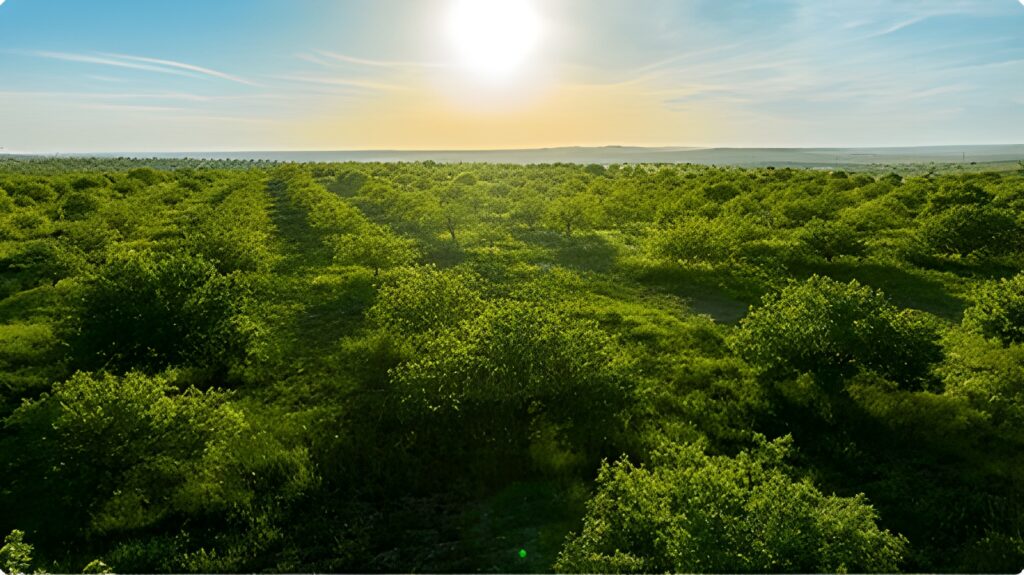
At Agro Vivero del Mediterráneo, we have accumulated vast experience accompanying farmers on the exciting journey of pistachio cultivation. We understand that a pistachio plantation is not just an investment in land, but a long-term life project. We know that the path to full production, although immensely rewarding, requires patience and impeccable financial planning. The pistachio, that prized nut, takes between 5 and 7 years to offer the first significant harvests and does not reach its maximum potential until after 10 or 12 years.
This initial period, where establishment and maintenance costs are constant but direct income from pistachios is zero, represents a considerable challenge. However, it is also a unique window of opportunity. Smart farm management during these years can not only mitigate the financial burden but also lay the foundation for a much more robust, resilient, and profitable agricultural business model.
Therefore, in this article, we want to share with you our vision and knowledge on how to diversify income on your pistachio farm. We will explore two main strategies that we have seen succeed on countless farms: intercropping and complementary activities. It is not about choosing one or the other, but understanding how they can be combined to create a productive and profitable ecosystem from day one. Join us on this journey and discover how to transform waiting time into an era of opportunities. At Agro Vivero del Mediterráneo, we are here to help you achieve it.
The Financial Challenge of the Early Years: Why Diversify?
Starting a pistachio plantation is a strategic decision that looks to the future. The initial investment is significant: land preparation, installation of an efficient irrigation system, and the acquisition of the highest quality plants, a factor we will never tire of insisting on. Choosing a good pistachio plant is the foundation on which all the future success of your farm will be built.
The expenses do not end there. During the first few years, the plantation requires constant care: weed control, fertilization, formative pruning, preventive phytosanitary treatments, and, of course, water and energy consumption. All these are operating costs that accumulate month by month, year after year, while the income account from the sale of the nut remains at zero.
This financial “journey through the desert” can generate stress and jeopardize the viability of the project if it has not been properly planned. This is where income diversification becomes an indispensable management tool. It is not a “plan B,” but an integral part of a well-designed “plan A.”
Diversifying allows you to:
-
Generate Short-Term Cash Flow: Obtain annual or semi-annual income that helps cover the maintenance costs of the main plantation. 💰
-
Reduce Risk: Relying on a single crop makes you vulnerable to market fluctuations, weather problems, or unexpected pests. Multiple income streams create a safety net.
-
Optimize Resources: Make the most of every square meter of your farm, every liter of water, and every hour of work.
-
Improve the Health of the Agricultural Ecosystem: As we will see, many diversification strategies contribute positively to soil health and farm biodiversity. 🌱
Understanding the long-term profitability of a plantation is crucial, but ensuring economic sustainability during the growth phase is even more so. Let’s now look at the specific strategies to achieve this.
Strategy 1: Intercropping, Taking Advantage of the Space Between Rows
One of the characteristics of pistachio plantations is their wide planting layout, generally 6×7 or 7×7 meters. During the first 7-8 years, the trees are small and leave an enormous amount of exposed and unused soil between the rows. This space is gold! Intercropping other crops is one of the most direct and intelligent ways to generate income while your pistachios grow.
What are Intercrops and Why Are They Ideal for Pistachios?
Intercropping consists of sowing another short-cycle crop in the available space between the rows of pistachio trees. The key is to choose species that do not compete aggressively with young pistachios for light, water, or nutrients and whose life cycle does not interfere with the maintenance tasks of the main plantation.
Key Advantages of Intercropping in Pistachio Plantations:
-
Quick Income: Many intercrops are harvested in a matter of months, providing vital cash flow.
-
Soil Improvement: Certain plants, such as legumes, fix atmospheric nitrogen in the soil, enriching it naturally and reducing the need for nitrogen fertilizers for the pistachios.
-
Weed Control: A well-established cover crop competes with weeds, decreasing the need for herbicides or mechanical tillage.
-
Irrigation Optimization: The already installed irrigation infrastructure is used, adjusting times and flow rates to meet the needs of both crops. 💧
-
Increased Biodiversity: They attract beneficial insects and improve soil microbial life, creating a more balanced and resilient agroecosystem.
The Best Intercrops for Your Pistachio Farm: Our Recommendations
From our experience at Agro Vivero del Mediterráneo, we have identified several groups of crops that work exceptionally well in synergy with the pistachio. The final choice will depend on your climate, soil type, water availability, and the local market.
1. Legumes: Soil Allies
They are perhaps the most beneficial option from an agronomic point of view.
-
Examples: Lentils, chickpeas, bitter vetch, peas, vetch.
-
Why do they work?: Their main advantage is nitrogen fixation. They grow low, so they do not shade the young pistachios. They are dryland crops or have low water needs, very adapted to our climate. In addition, they have good market demand. Vetch, for example, can be mowed and sold as high-quality forage or incorporated into the soil as green manure.
2. Short-Cycle Winter Cereals: Cover and Grain
They are an excellent option to keep the soil covered during the winter, preventing erosion.
-
Examples: Barley, oats, triticale.
-
Why do they work?: They are sown in autumn and harvested in late spring, just before the pistachios enter their period of maximum summer water demand. They protect the soil, control weeds, and the grain or forage harvest generates direct income. It is crucial to control the seeding rate so as not to create excessive competition.
3. Low-Growing, High-Value Horticultural Crops: The Profitable Challenge
This option requires more intensive management but can offer the highest economic returns.
-
Examples: Garlic, onions, melons, watermelons, zucchini.
-
Why do they work?: They are high value-added crops with well-established markets. Garlic and onions, for example, have a cycle that adapts well and water needs that can be managed. Melons or watermelons take advantage of the summer heat and available space, although their water demand is higher and must be carefully monitored. 🍉
4. Aromatic and Medicinal Plants: Niche Diversification
An increasingly popular option due to its resilience, low water consumption, and high market value.
-
Examples: Lavender, rosemary, thyme, oregano, and the king of high-value crops, saffron.
-
Why do they work?: They adapt perfectly to arid conditions. Once established, their water needs are minimal. They can give rise to high-value products (essential oils, condiments, infusions). Saffron, for example, is harvested in autumn, does not interfere at all with the pistachio, and its profitability per hectare is very high. In addition, an intercropped lavender plantation can be an incredible visual attraction and the first step towards agrotourism. 💜
Critical Considerations Before Intercropping
Before you start sowing, good planning is essential. In our technical advisory services, we always emphasize these points:
-
Competition for Resources: Analyze the water and nutrient needs of both crops to design a fertigation plan that satisfies both without generating deficiencies.
-
Machinery Management: Make sure the intercrop does not prevent the passage of tractors and machinery to carry out the necessary tasks on the pistachios (treatments, pruning, etc.). 🚜
-
Phytocompatibility: Avoid intercropping crops that share major pests or diseases with the pistachio so as not to create a focus of sanitary problems.
-
Market Analysis: Do not sow anything without first knowing who and how you are going to sell it to. Research local markets, prices, and necessary logistics.
Strategy 2: Complementary Activities, Beyond the Land
Diversification is not limited to planting other crops. Your farm is an asset with potential that goes much further. Developing complementary activities can transform your farm into a multifaceted and dynamic business, especially once the pistachios are visible and form an attractive landscape.
Expanding Horizons: Activities that Add Value to Your Farm
These strategies take advantage of existing resources (the farm itself, by-products, the landscape) to create new lines of business. They often require a more entrepreneurial mindset, but their rewards can be enormous.
1. Agrotourism: “Pistachio Tourism” 🧑🌾
Interest in the origin of food and authentic experiences is booming. Your pistachio farm can become a destination.
-
What does it consist of?: Offering guided tours where you explain the pistachio cycle, from flowering to harvest. Organizing harvesting workshops in season. Conducting tastings of your nut in its different presentations (natural, roasted, salted).
-
What do you need?: A minimal reception area, setting up some toilets, and above all, passion for communicating your work. You don’t need a large infrastructure to start.
-
Income streams: Charging for the visit/experience, and direct sale of your products on the farm, where margins are maximum. Imagine selling your first batch of pistachios directly to people who have seen how you care for them.
2. Beekeeping: A Sweet and Profitable Synergy 🐝
Bees and agriculture are natural allies. Integrating beehives on your farm is one of the most perfect synergies.
-
Why does it work?: Although the pistachio is anemophilous (pollinated by the wind), the presence of bees on the farm greatly increases biodiversity and the presence of auxiliary fauna that helps control pests. The main benefit is, of course, honey production.
-
The added value: You can market a “Pistachio Farm Honey,” a unique product with a powerful story. In addition to honey, other hive products such as pollen, propolis, or wax can be obtained. It is an activity with a low initial investment that generates a highly demanded non-perishable product.
3. Controlled Extensive Livestock Farming: Natural “Brushcutters” 🐑
Integrating a small flock of sheep or even poultry can be an incredibly effective management tool.
-
What does it consist of?: Using controlled sheep grazing to keep weeds at bay in the plantation alleys.
-
Benefits: Drastic reduction in the use of herbicides and mechanical tillage, which means savings in costs and fuel. The animals naturally fertilize the land with their droppings. In addition, it generates an additional income stream from the sale of lambs or wool.
-
Precautions: It is absolutely crucial to protect young trees with individual protectors until their trunk is robust enough. The stocking rate must be managed to avoid soil compaction.
4. Utilization of Pruning Biomass 🔥
Every year, pistachio pruning generates a considerable amount of woody debris. Instead of seeing it as a waste to manage, we can see it as a valuable by-product.
-
How?: Firewood from pruning can be shredded to produce biomass for stoves and boilers, or chopped and sold as firewood for fireplaces and barbecues.
-
Advantages: Transforms a cost (waste management) into an income. Promotes the circular economy within the farm itself and reduces dependence on fossil fuels if used for self-consumption.
5. Creation of Own Brand and Direct Sales 🏷️
This is the culmination of the diversification process. It is a longer-term strategy, but the one that offers the greatest profitability potential.
-
The goal: Stop selling your pistachio as a bulk raw material and start selling a final product, with your own brand, directly to the consumer.
-
The process: Involves processing the nut (drying, hulling, roasting, salting), packaging, and marketing. You can start on a small scale, selling in local markets, through a simple website, or directly on the farm thanks to agrotourism.
-
The power of the brand: Your own brand allows you to tell your story, differentiate yourself by quality, and capture all the value of the chain. Instead of selling at €3-4/kg in the field, you could sell your packaged product at €20-30/kg or more. If you are thinking of a project on this scale, it is vital to plan it from the beginning. We invite you to use our reservation and quote form so we can help you design a comprehensive plan.
What is the Best Strategy for Me? Your Farm, Your Decision
After exploring this range of possibilities, the question is inevitable: where do I start? Which strategy is best for my farm? The answer, as almost always in agriculture, is: it depends. There is no universal magic formula. The best strategy is the one that adapts to your particular circumstances.
At Agro Vivero del Mediterráneo, we believe in tailor-made solutions. Therefore, we encourage you to reflect on these key factors:
-
Your Location: Is your farm near tourist areas or urban centers? This is key for agrotourism or direct sales. What is the access like?
-
Your Water Resources: Water availability is the most limiting factor. Intercropping horticultural crops is unfeasible without guaranteed water, while saffron or dryland legumes are much more tolerant.
-
Your Soil Type: Conduct a soil analysis. It will tell you which intercrops will adapt best and what amendments you might need.
-
Your Investment Capacity: Some activities like beekeeping or firewood utilization require a low initial investment. Others, like setting up a small packaging line, are more demanding.
-
Your Time and Knowledge: Be honest with yourself. Do you have the time and desire to manage a tourist activity? Or do you prefer to focus on purely agricultural tasks?
-
The Local Market: Research what products are in demand in your area. Perhaps there is a niche for purple garlic, or a honey cooperative looking for new members.
The best approach is usually to start small. Perhaps the first and second year you focus on a simple intercrop like legumes to improve the soil. By the third or fourth year, with the trees already more formed, you can introduce a small flock of sheep. And once you have the first harvests, you can start planning direct sales and the first agrotourism experiences.
Conclusion: A Prosperous and Resilient Future
Pistachio cultivation is undoubtedly one of the most promising agricultural adventures of our time. But success lies not only in producing a high-quality nut, but in building a diversified and sustainable business model that gives you peace of mind and profitability from the beginning.
Diversification strategies, whether through intercropping or complementary activities, are not a temporary patch, but a smart investment in the resilience of your farm. They allow you to optimize your resources, generate income during the waiting years, and build a stronger business less vulnerable to unforeseen events.
At Agro Vivero del Mediterráneo, our mission goes beyond providing you with the best pistachio plant. We want to be your strategic partners on this path. We bring our extensive experience and technical knowledge to help you design a diversification plan that perfectly fits your project, your land, and your dreams.
Do not leave the future of your investment to chance. The time to plan diversification is now, at the beginning of the project. Contact us today. Let’s talk about your farm, your goals, and how, together, we can design a comprehensive plan so that your pistachio farm is a resounding and profitable success from day one. 🚀